Reduce picking errors, improve operator guidance and accelerate production workflows with industrial pick-to-light and put-to-light systems designed specifically for manufacturing environments.
At Ansomat, we provide configurable light-guided picking solutions for assembly lines, kitting stations and high-mix production environments where accuracy, traceability and operator support are critical.
Unlike traditional warehouse-focused picking systems, our platform is built for production and assembly operations, combining pick-to-light, put-to-light, digital work instructions and operator validation in one integrated solution.


Pick-to-light systems (also known as pick to light systems or pick-to-light solutions) are visual operator guidance systems that direct workers to the correct components using illuminated indicators, projections, or wearable technologies.
As a core part of modern pick to light software, these systems guide operators through each step of the picking process with speed and precision, whether at fixed stations or using mobile solutions such as a pick to light cart.
When a part must be picked, the corresponding location lights up and the operator receives clear visual confirmation of:
Each picking action can be digitally validated through pick-to-light software, improving traceability, enabling real-time monitoring, and significantly reducing operator mistakes.
Pick-to-light systems are commonly used in:
Typical pick-to-light systems examples include line-side kitting, guided assembly stations, and mobile workflows enabled by a pick to light cart in dynamic production environments.
While pick-to-light systems guide operators on what to pick, related systems such as put-to-light solutions are used to direct where items should be placed or sorted in downstream processes.
Manufacturers use pick-to-light systems to improve operational efficiency and reduce human error during manual assembly and kitting processes.
Guide operators visually to the correct components and validate every pick digitally.
New operators can follow intuitive light-guided workflows with minimal training.
Every picking action is tracked and linked to the production process.
Operators spend less time searching for components and interpreting paper instructions.
Easily adapt workflows, variants and product configurations without complex PLC programming.
Combine visual picking with digital work instructions, torque validation, barcode scanning and machine vision in one connected platform.

Put-to-light systems guide operators where to place, distribute or sort parts during manufacturing and kitting operations.
Instead of guiding a pick action, illuminated indicators show the correct destination location for each component or assembly.
Put-to-light systems are commonly used for:
In manufacturing environments, pick-to-light and put-to-light technologies are often combined to create fully guided workflows from component picking through final assembly preparation.
Ansomat supports both pick-to-light and put-to-light workflows within the same operator guidance platform.
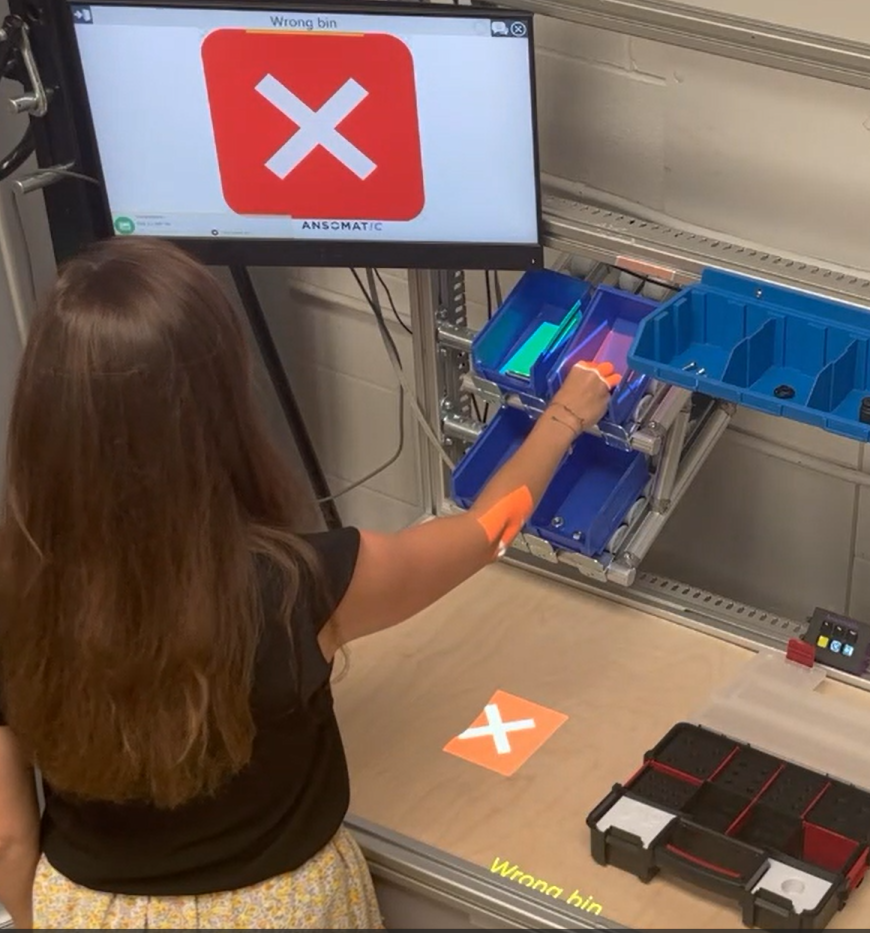
Projection-based pick-to-light systems use visual projections to highlight the exact picking location.
Combined with 3D sensors, the system validates that the operator’s hand entered the correct picking zone.
Advantages:
This approach is especially useful in dynamic assembly and high-mix manufacturing environments.

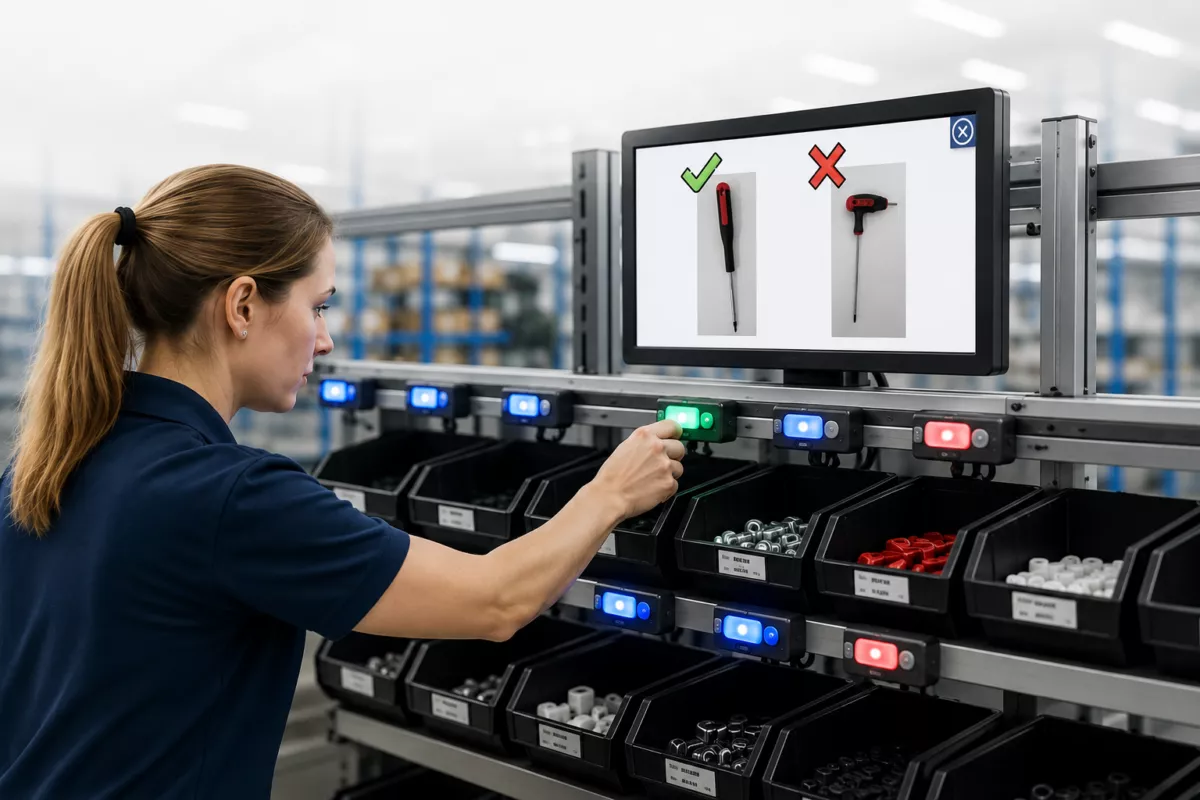
Illuminated pick-to-light modules are mounted directly on storage bins or picking locations to guide operators to the correct components.
Features include:
These systems are ideal for repetitive and high-volume manufacturing environments.

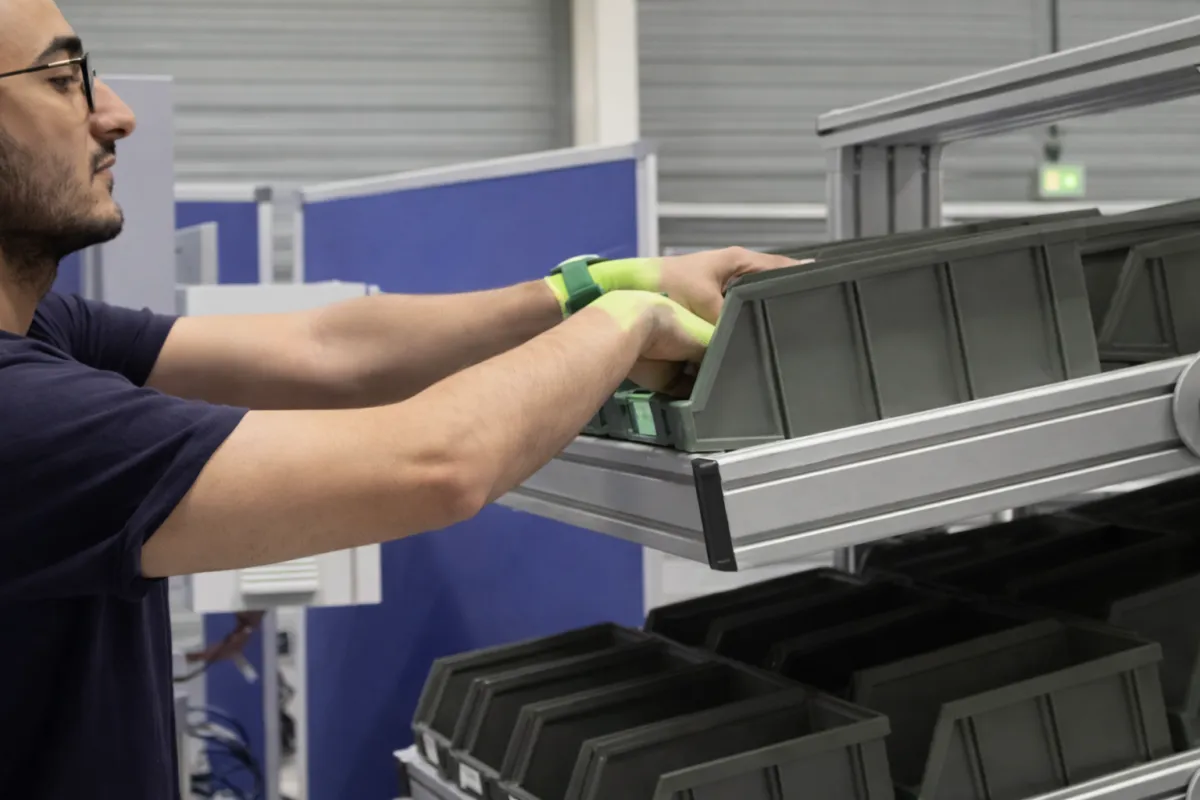
Wearable picking systems use wristbands or wearable devices to validate operator movements and picking actions digitally.
These systems provide:
Wearable guidance is particularly effective in complex manufacturing environments where operators move frequently between workstations or picking zones.

A pick-to-light system is a visual operator guidance solution that uses illuminated indicators, projections or wearable devices to direct operators to the correct picking location during manufacturing, assembly or kitting operations.
Pick-to-light is a visual picking system that uses lights, such as sensors, projector, PTL to guide operators to the correct parts. When an order starts, lights illuminate at the right bins and show the required quantity. The operator picks the items and confirms the action (e.g. via a button or sensor).
The cost of a pick to light system depends on several factors, primarily the size of your operation. For traditional pick-to-light sensors, the main cost driver is the number of bins, as each bin requires its own sensor. In this case, the total investment is largely determined by the number of sensors needed, along with the required I/O modules.
An alternative approach uses a 3D sensor in combination with a projector. Here, the cost is more centralized, you typically invest once in the 3D sensor system, but this setup requires a fixed and stable work area.
Pick-to-light systems typically cost from around €1,000 for smaller setups, while larger installations can run into several thousand euros or more.
Pick-to-light systems increase efficiency by eliminating search time and simplifying decision-making for operators. Lights indicate exactly where to pick, which leads to faster picking speeds, fewer mistakes, and more consistent workflows.
Pick-to-light systems guide operators through EV battery module assembly by indicating the correct picking location and sequence. This ensures accurate component selection, reduces picking errors and improves full production traceability.
Manufacturers using pick-to-light in battery assembly report near-zero picking errors and faster operator onboarding.
→ See how VDL Nedcar eliminates operator mistakes with pick-to-light.
In aerospace manufacturing, pick-to-light systems ensure the correct tools are picked, used and returned, helping prevent FOD (Foreign Object Debris) and improving tool room traceability.
This results in reduced compliance risks, improved accountability and error-proof tool management.
→ Learn how pick-to-light prevents FOD in aerospace.
Pick-to-light systems accelerate production kitting by guiding operators to pick all required components accurately, reducing missing parts and rework during assembly.
Companies implementing pick-to-light in kitting processes typically achieve faster kit preparation and significantly fewer picking errors.
→ Explore this production kitting case.
At manual assembly workstations, pick-to-light systems combine with digital work instructions, torque tools and barcode scanning to create fully guided workflows.
This enables no-fault-forward assembly, reduces operator errors and improves overall production quality.
→ See how an engine builder achieves error-free assembly with pick-to-light operator guidance.
Pick-to-light systems support high-mix manufacturing by guiding operators through frequently changing product variants without complex reconfiguration.
This improves flexibility, reduces training time and ensures consistent picking accuracy across dynamic production environments.
Unlike traditional pick-to-light suppliers focused on warehouse logistics, Ansomat specializes in operator guidance for manufacturing and assembly environments.
Designed specifically for assembly, production and industrial kitting operations.
Configure workflows, bin locations and process logic using an intuitive software interface.
Combine:
within a single ecosystem.
Picking is only one part of the process. Operators also receive contextual instructions, validation and process control directly at the workstation.
Integrate with:
for complete shop-floor connectivity.

Step into the future of guided manufacturing.