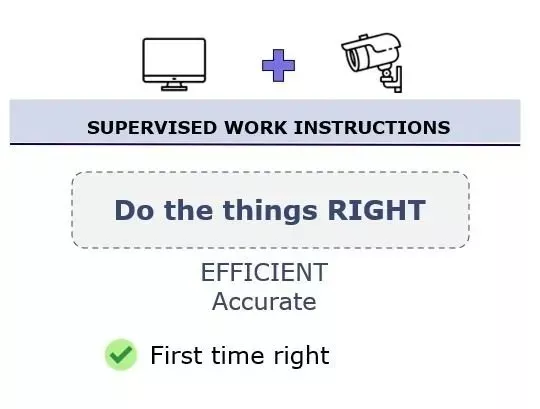
Digital work instructions are essential for guiding operators to do the right thing. But while they define what needs to be done, they don’t always guarantee that each step is executed correctly.
That’s where vision systems play a vital role, validating every step of the process to ensure consistent, error-free execution. It’s not just about doing the right work, it’s about doing the work right.


Machine vision uses cameras, image processing and software to automatically inspect products, components and manufacturing processes.
A machine vision camera captures images of the product or work area. The vision system processes these images and determines whether predefined requirements have been met.
Using technologies such as 2D vision, machine vision systems can recognize shapes, colors, positions and surface characteristics, verify the presence or absence of components, and track objects throughout a manufacturing process.
More advanced AI machine vision can identify complex irregularities and support automated visual inspection where conventional rule-based inspection may not be sufficient.

If these situations sound familiar, your production line could greatly benefit from machine vision and vision-based error-proofing:
By combining machine vision for manufacturing with operator guidance, manufacturers can create a controlled process in which operators receive the correct instructions while the vision system automatically verifies their execution. This helps detect errors at the source, improve quality, and prevent incorrect products or assemblies from progressing through production.
Even skilled operators can make mistakes. Machine vision systems continuously monitor manual actions and verify that each step is performed correctly. Using machine vision cameras and image-processing algorithms, the system can check component presence, positioning, and operator actions in real time. Errors are detected immediately, helping improve first-time-right performance and production consistency.
The earlier an error is detected, the lower its impact. Vision systems for manufacturing identify defects where they occur, from missing or misplaced components to assembly mistakes and visual irregularities. With automated visual inspection, manufacturers can catch errors before they move downstream, reducing rework and improving quality.
Machine vision solutions can automatically verify when a production step has been completed correctly, eliminating the need for operators to manually confirm each action. Once verified, the vision system triggers the next instruction or process step. This creates a faster, smoother workflow while ensuring production only moves forward when the required conditions are met.

Advanced AI-powered machine vision systems provide operators with real-time feedback when an error is detected. By identifying the cause of potential mistakes, machine vision AI helps operators understand what went wrong, take immediate corrective action, and quickly resume production.
This real-time feedback supports faster error resolution, reduces downtime, and improves quality across the manufacturing process.

Provide clear reason codes and corrective guidance when errors occur

Repair flow is triggered if system fails to detect required action

Live video feeds from the vision system to increase transparency actions

Vision systems that track and validate moving objects

From simple presence/absence detection to complex inspection
Digital operator guidance ensures workers receive the right instructions at the right time. Adding machine vision validation takes this a step further by automatically verifying that critical actions have been performed correctly.
| Operator Guidance Without Machine Vision | Operator Guidance With Machine Vision Validation |
| Guides operators through each production step | Guides operators and verifies correct execution |
| Operator manually confirms task completion | Machine vision automatically validates completion |
| Relies more heavily on operator judgment | Provides objective, repeatable visual verification |
| Errors may be detected during later quality checks | Errors can be detected immediately at the source |
| Instructions help prevent incorrect actions | Machine vision systems detect missing, misplaced or incorrect components |
| Manual visual inspection may be required | Automated visual inspection can verify product and assembly quality |
| Process advances after operator confirmation | Process can advance automatically after successful vision validation |
| Limited real-time feedback on incorrect execution | Operators receive immediate feedback when an error is detected |
Combining operator guidance with machine vision creates a closed-loop manufacturing process: the system guides the operator, validates execution in real time, and only allows production to move forward when the required conditions are met.






Machine vision is used to automatically inspect products, components and manufacturing processes. It can verify whether parts are present, correctly positioned or properly assembled, identify product variants, detect visible defects and confirm that operators have completed critical process steps correctly.
When connected to operator guidance, machine vision can also prevent the workflow from continuing until the required condition has been verified.
Digital work instructions tell the operator what to do, while machine vision verifies the result.
For example, an instruction may tell an operator to install a specific component. Once the action is completed, the vision system inspects the workstation or product. If the component is present and correctly positioned, the next instruction can be released automatically.
This creates a closed-loop process:
Guide → Perform → Verify → Continue
Depending on the camera, lighting and inspection technology, machine vision can detect errors such as:
The exact inspection capabilities depend on the application and how clearly the required condition can be identified visually.
Traditional machine vision generally uses predefined rules to inspect characteristics such as shape, position, dimensions, contrast or color.
AI machine vision learns visual patterns from examples and can be useful when defects or acceptable conditions are more variable and difficult to describe with fixed rules.
Rule-based vision is often suitable for predictable inspection tasks, while AI can add value in more complex applications involving visual variation or irregular defects.
No.
Many manufacturing applications can be solved effectively with conventional rule-based machine vision. Simple presence checks, positioning, color detection and other clearly defined inspections may not require AI.
AI is most valuable when the visual conditions are too complex or variable for reliable rule-based inspection.
The objective should always be to use the simplest vision technology that reliably meets the inspection requirement.
Machine vision can automate many repetitive visual inspections, but it does not automatically replace every manual quality check.
It works particularly well when inspection criteria can be defined visually and checked consistently by a camera system.
Human inspection may still be appropriate when the task requires judgement, tactile feedback or characteristics that cannot be reliably observed by the vision system.
In many applications, machine vision is therefore used to automate repetitive checks while operators focus on tasks that require human expertise.
Yes.
Machine vision can monitor the work area and verify that expected conditions are met after an operator performs an action.
For example, it can check whether the correct component has been installed, whether it is positioned correctly or whether an assembly step has been completed.
When an error is detected, the operator can receive immediate feedback and the production process can be prevented from moving forward until the issue has been corrected.
Yes. Machine vision systems can detect and track objects as they move through the camera's field of view.
This can be useful for dynamic manufacturing processes where products, components or operator actions do not always occur in exactly the same position.
The required camera, processing technology and tracking method depend on the speed and complexity of the application.
A reliable machine vision application depends on more than the camera itself.
Important factors include:
For AI-based applications, suitable training examples and model validation are also important.
Good application design is often more important than simply selecting the most advanced camera.