


RTLS (Real time location systems) for manufacturing enables real-time tracking of tools, operators, assets, and materials across the shop floor.
Industrial RTLS systems help manufacturers improve assembly verification, reduce operator errors, optimize workflows, and achieve full production traceability through precise 3D location tracking.

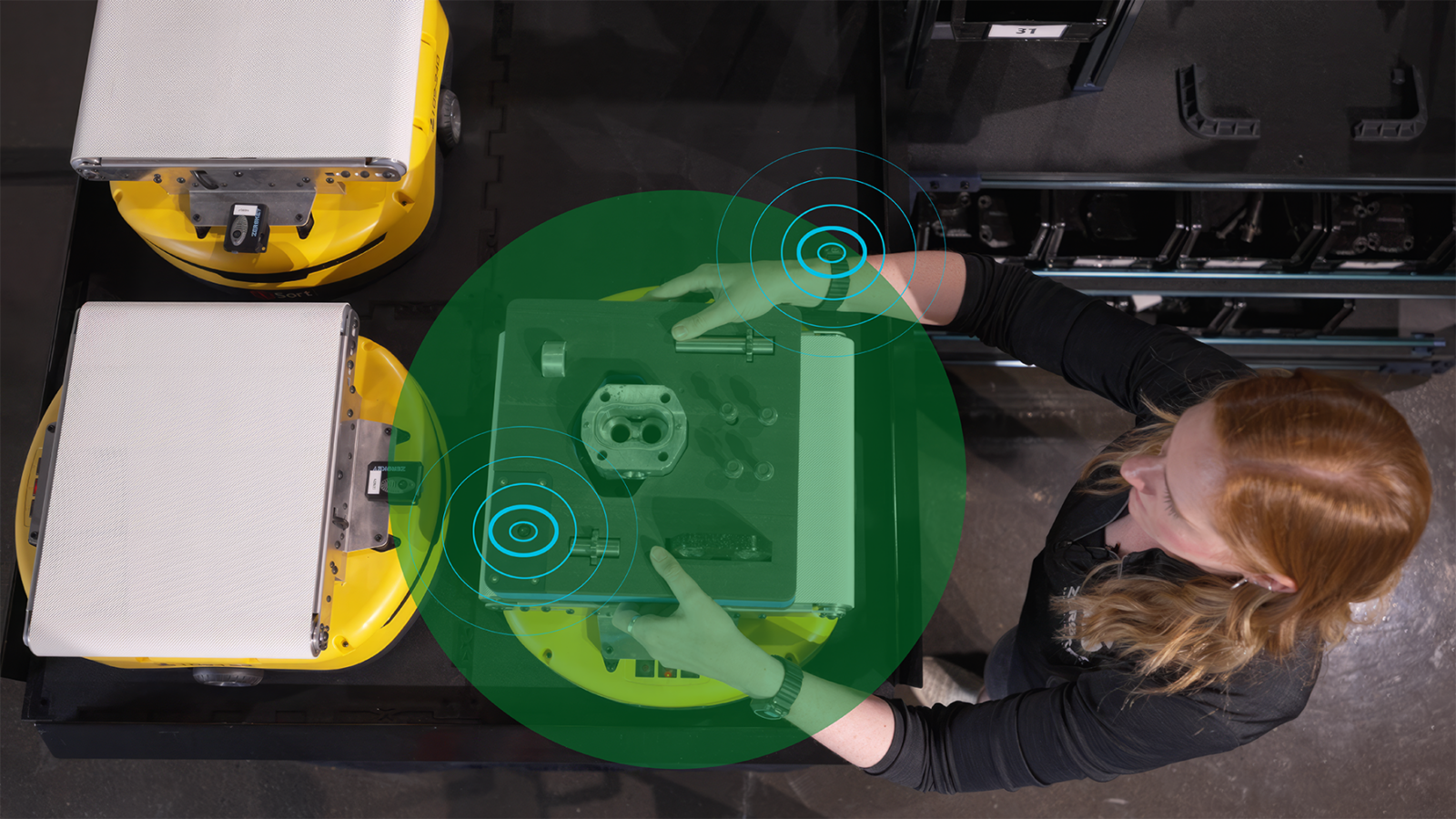
As modern manufacturing evolves, the need for precise, reliable, and continuous tracking across the shopfloor has never been greater. With real-time visibility of tools, people, assets, and materials, manufacturers can now streamline operations, enhance workplace safety, and enable data-driven process control like never before.
A Real-Time Location System (RTLS) creates a digital twin of your shopfloor, constantly monitoring the 3D position of tagged objects. Using advanced ultrasonic technology, strategically placed anchors across the facility capture the exact spatial location of each tag with hyper-accurate precision. Consequently, manufacturers can track tool movements, verify worker actions, and optimize material flow and this all in real time.

An ultrasonic-based RTLS system is a real-time location tracking solution used in manufacturing to accurately track tools, assets and operators in 3D space. The system works by using wireless RTLS tags attached to objects, combined with a network of fixed anchors installed across the shopfloor. These anchors transmit and receive ultrasonic signals, allowing the RTLS system to calculate the precise location of each tag in real time.
Because ultrasonic signals travel at a constant speed, the system can determine distances with extremely high accuracy, often achieving millimeter-level precision. This enables reliable RTLS tracking of tool positions, operator movements and manual actions, even in complex or obstructed environments. Unlike camera-based systems, RTLS does not rely on line-of-sight, making it ideal for indoor positioning, assembly operations and high-mix manufacturing workflows where full visibility and accuracy are critical.

If your shop floor faces any of the following challenges, it’s time to transition toward a mobile, data-driven RTLS solution:
RTLS systems provide precise 3D tracking of fastening tools across all orientations, enabling full horizontal and vertical tool position control on the shop floor. As an advanced RTLS tracking system, it continuously measures the exact spatial position of each tool, regardless of how it is held or used by the operator.
This real-time RTLS location tracking ensures consistent accuracy whether tools are upright, angled or inverted, making it ideal for complex assembly operations. By eliminating variability in tool positioning, RTLS systems help manufacturers improve assembly quality, validate torque sequences and ensure repeatable process accuracy.
As a result, RTLS for manufacturing improves consistency, reduces human error and enhances production traceability across all workstations.
RTLS tracking systems deliver reliable real-time location data even in complex or hard-to-reach areas of the manufacturing environment. Unlike camera-based systems, which rely on line-of-sight, RTLS solutions use strategically placed anchors and RTLS tags to track tools, assets and operators without visual limitations.
This allows accurate RTLS location tracking in obstructed zones, under equipment or inside large assemblies where traditional systems struggle. RTLS systems can also be easily scaled by adding additional anchors, without requiring complex recalibration.
This flexibility makes RTLS for improving manufacturing workflows highly effective, ensuring full visibility, better process control and optimized operational efficiency across the entire facility.

RTLS systems can also be used to automate and validate manual processes such as picking, kitting and assembly actions. By using RTLS tracking of operator hand movements, manufacturers can enable hands-free confirmation without physical buttons or scanners.
It works like a pick-to-light system. With RTLS tags embedded in wearable devices such as bracelets, operators can interact with projection-based operator guidance systems. When the operator’s hand enters a defined zone, the RTLS system automatically registers the action and advances the workflow.
This approach improves workflow efficiency, reduces operator errors and enhances ergonomics while maintaining full process traceability. It also supports more intuitive and hygienic human-machine interaction, making it a key RTLS solution for modern manufacturing environments.


RTLS in manufacturing is used to track and validate the real-time location of tools, assets and operators across the shop floor. By providing continuous visibility into movements and processes, RTLS improves production traceability, reduces search time and enables more efficient, data-driven workflows.
RTLS provides continuous, real-time location tracking of objects within a space, allowing manufacturers to monitor movement and position at any moment. RFID, on the other hand, is typically used for identification at specific checkpoints, such as scanning a part at a workstation, rather than tracking its continuous movement.
Real-Time Location Systems (RTLS) can use different underlying technologies to track the position of tools, assets and operators. The most common are Wi-Fi, Bluetooth, Ultra-Wideband (UWB) and ultrasonic RTLS. The key difference between them lies in how they measure distance and the level of accuracy they can achieve.
Wi-Fi-based RTLS uses existing wireless infrastructure to estimate location, typically based on signal strength (RSSI). While easy to deploy, Wi-Fi systems offer relatively low accuracy, usually within several meters. This makes them suitable for general asset tracking, but not for precision manufacturing applications.
Bluetooth Low Energy (BLE) systems also rely on signal strength to estimate position. They are more cost-effective and energy-efficient than Wi-Fi, but accuracy is still limited, typically ranging from 1 to 5 meters. Bluetooth RTLS is often used for basic indoor tracking but lacks the precision needed for assembly validation or tool positioning.
UWB systems use radiofrequency signals with precise time-of-flight measurements to calculate distance. This allows for higher accuracy than Wi-Fi or Bluetooth, typically in the range of 10–30 cm. However, in industrial environments with metal surfaces, UWB signals can suffer from multipath interference, where reflections distort positioning accuracy.
Ultrasonic RTLS systems use sound waves to measure distance between tags and anchors. Because ultrasound travels much slower than radiofrequency signals, distance measurements can be made with extremely high precision.
This enables positioning accuracy down to 1.5 mm, making ultrasonic RTLS ideal for demanding manufacturing applications such as tool position control, assembly verification and real-time operator guidance.
In addition, ultrasonic signals behave differently in industrial environments. Instead of reflecting sharply like RF signals, they diffuse and dissipate, reducing the impact of multipath interference. This makes ultrasonic RTLS more reliable in environments with high volumes of metal, where traditional RF-based systems often struggle.
Industrial RTLS systems provide measurable improvements in production performance by enabling real-time visibility and control across the shopfloor.
Manufacturers implementing RTLS tracking systems often achieve faster workflows, improved accuracy and better operational visibility.
When combined with operator guidance, RTLS systems and machine vision technologies create a powerful foundation for error-proof manufacturing and process reliability. While both technologies improve production quality and efficiency, they serve different purposes on the shop floor.
RTLS (Real-Time Location Systems) focus on real-time location tracking, while machine vision systems specialize in visual inspection and defect detection. Understanding their strengths and trade-offs helps manufacturers choose the best solution—or combination—for their workflows.
Advantages
Trade-offs

Advantages
Trade-offs

| Feature | RTLS | RFID | Machine Vision |
|---|---|---|---|
| Real-time tracking | Yes | Limited | No |
| Continuous positioning | Yes | No | Limited |
| 3D tool tracking | Excellent | Weak | Moderate |
| Line-of-sight needed | No | No | Yes |
| Operator tracking | Yes | Limited | Limited |
| Assembly validation | Strong | Weak | Moderate |
| Industrial scalability | High | Moderate | Moderate |