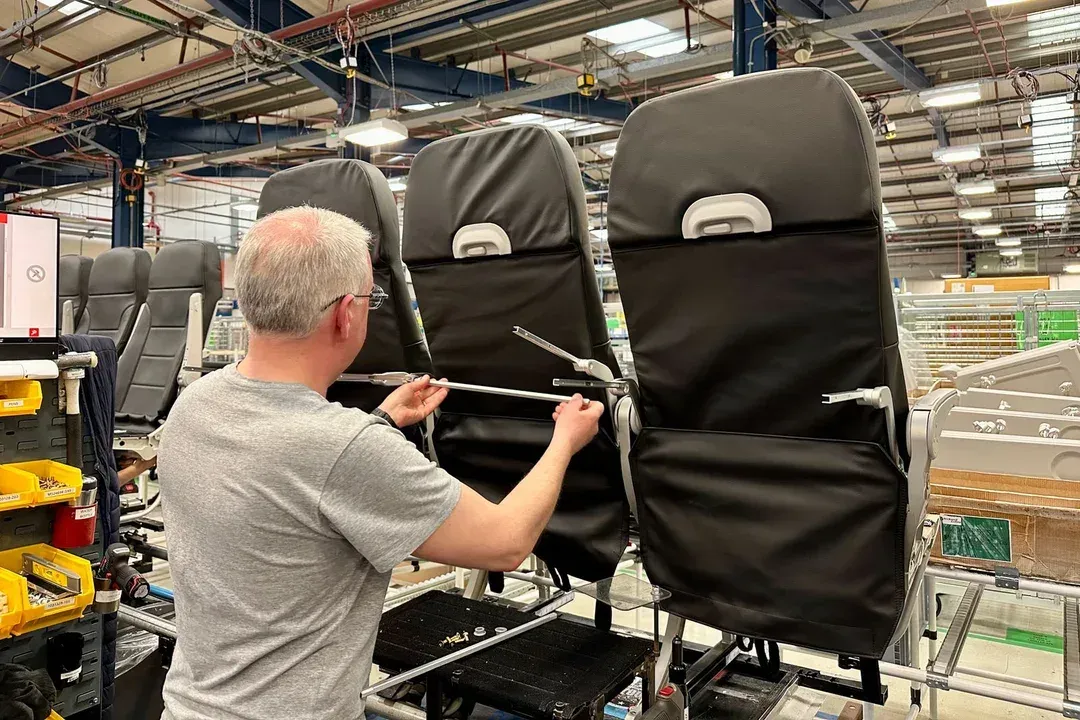
Foreign Object Debris (FOD) is a major safety and quality risk in aerospace and other critical manufacturing environments. A forgotten or unaccounted-for tool can result in damaged equipment, production delays, costly inspections and serious safety consequences.
Ansomat helps manufacturers prevent FOD by digitizing tool room picking and kitting, controlling tool check-in and check-out, and creating complete traceability of who picked each tool, when it was used and whether it was returned.
Combined with technologies such as barcode and RFID identification, pick-to-light, digital work instructions and operator action tracking, the system creates a closed-loop tool control process where every tool is accounted for.
Traditional tool rooms often rely on paper logs, manual checks or operator memory. In complex aerospace and defence manufacturing environments, these methods make it difficult to guarantee that every tool has been returned after a production or maintenance operation.
Typical risks include:
For safety-critical manufacturing, simply knowing which tools should be available is not enough. Manufacturers need a controlled process that verifies which operator picked which tool, for which job, and whether every tool was returned.
Ansomat digitizes the complete tool room workflow, from operator identification and tool selection through checkout, use and return.
Instead of relying on manual administration, operators are guided through the required tool picking and kitting process step by step.
The system can combine:
This creates an error-proof tool management process designed to reduce FOD risk and ensure every tool remains traceable throughout the operation.
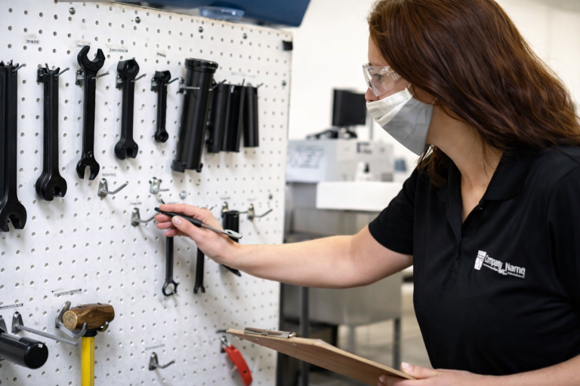
Operators identify themselves before tools can be issued. This establishes a digital link between the operator, production task and tools being used.
The operator receives a digital checklist showing the tools required for the specific job.
Using [Digital Work Instructions], manufacturers can guide operators through the process step by step instead of relying on paper instructions or memory.
Operators are guided toward the correct tools required for the operation.
Depending on the tool room configuration, Ansomat can use pick-to-light, barcode scanning, RFID and other operator guidance technologies to make tool selection faster and less error-prone.
Every controlled tool can be uniquely identified using barcode or RFID technology.
When a tool is picked, it is scanned and digitally assigned to the operator and job.
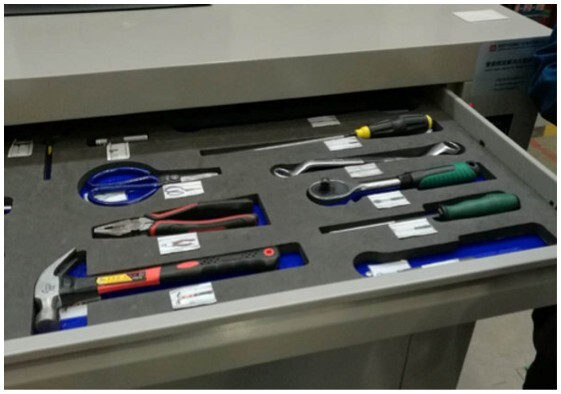
Required tools are organized into a job-specific kit, such as a foam-cut tool board.
This provides an additional visual control mechanism while the operator works and makes missing tools immediately easier to identify.
Every relevant action can be recorded automatically, creating a digital history of the process.
Manufacturers can determine:
Learn more about [Operator Action Traceability].
After the operation is completed, tools are scanned back into the tool room.
The system verifies that required tools have been returned, helping prevent a missing tool from going unnoticed.
This closes the loop between tool picking, tool usage and tool return.
Pick-to-light can further improve tool room picking by visually directing operators to the correct tool or storage location.
Instead of searching through drawers, racks or tool cabinets, operators receive a clear visual indication of where the required item is located.
For aerospace tool control, pick-to-light can help:
Pick-to-light can also be combined with barcode scanning, RFID, digital work instructions and operator identification to create a fully guided tool room workflow.
Explore Ansomat's [Pick-to-Light Systems for Manufacturing].
With controlled tool picking, kitting and digital traceability, manufacturers can achieve:
Effective FOD prevention requires more than finding a missing tool after an incident.
The objective is to build a manufacturing process where every controlled tool is identified, picked, tracked and returned.
By combining operator guidance, picking and kitting, digital work instructions, barcode or RFID identification, pick-to-light and action traceability, manufacturers can create a closed-loop system for tool control.
Ansomat provides the operator guidance and traceability technology required to connect these steps into one controlled digital workflow.
In critical manufacturing environments, safety depends on knowing that every tool is accounted for. Ansomat’s tool room solution closes the loop — ensuring no tool ever goes missing without being noticed.
Traditional tool room processes often depend on paper checklists, manual sign-out procedures and operator memory. A digitally controlled tool room combines guided picking, identification and traceability to help ensure every tool is correctly picked, used and returned.
| Tool room process | Traditional / Manual Approach | Ansomat Digital FOD Prevention |
| Tool picking | Operator searches for the required tools manually | Guided tool picking directs the operator to the correct tool |
| Pick-to-light | No visual guidance; depends on operator knowledge | Pick-to-light visually indicates the correct tool or storage location |
| Tool kitting | Kits prepared manually with limited validation | Guided picking and kitting verifies that the correct tools are included |
| Tool identification | Visual identification or manual records | Barcode or RFID identifies each controlled tool |
| Tool checkout | Paper log, spreadsheet or manual sign-out | Tool checkout is digitally linked to the operator and job |
| Work instructions | Paper instructions or operator memory | Digital work instructions guide the operator step by step |
| Picking validation | Limited confirmation that the correct tool was selected | Picking actions can be digitally validated before the process continues |
| Operator traceability | Difficult to determine who performed each action | Operator actions are automatically recorded and time-stamped |
| Tool usage history | Records may be incomplete or difficult to retrieve | Complete digital history of tool picking, usage and return |
| Tool return | Operator manually returns tools | Tools are scanned and validated when returned |
| Missing tool detection | Missing tools may only be noticed during a later check | Digital records make it easier to identify which tool is missing and who last used it |
| FOD prevention | Relies heavily on procedures and operator discipline | Closed-loop tool control helps prevent tools from being left in aircraft, assemblies or equipment |
| Audit trail | Paper records must be manually reviewed | Digital traceability provides a searchable history of operator and tool actions |
| Process control | Errors may only be discovered after the operation | Guided and validated workflows help prevent errors at the point of execution |
See how Ansomat can help you secure, track, and audit every tool in your operation.