VDL transformed its EV battery assembly process from a manual, operator-dependent workflow into a fully digital, error-proof manufacturing system using the Ansomat Operator Guidance System. By combining digital work instructions, projected picking, machine vision, smart tool integration, and real-time process validation, every battery assembly step is guided and verified before production can continue. The result is a standardized assembly process that eliminates operator mistakes, supports multiple battery variants, reduces training time, and provides complete traceability for every battery produced. With digital quality verification built into every operation, VDL can confidently deliver consistent, first-time-right production while meeting the demanding quality standards of the electric vehicle industry.
Increased traceability and process consistency
VDL Nedcar is one of Europe's leading automotive manufacturers, producing vehicles and battery systems for multiple OEMs. As electric vehicle production continues to grow, manufacturers face increasing pressure to assemble increasingly complex battery packs while maintaining the highest quality and safety standards.
Unlike conventional automotive assembly, EV battery production involves high-voltage components, strict traceability requirements, multiple product variants, and complex manual assembly operations. Every assembly step must be completed correctly the first time to ensure product safety, reliability, and regulatory compliance.
To support these requirements, VDL Nedcar partnered with Ansomat to digitize its manual battery assembly process using intelligent operator guidance.
Manual EV battery assembly presents unique manufacturing challenges. Operators must accurately identify, pick, and assemble hundreds of components while working with multiple battery variants for different vehicle platforms and OEM customers. Every incorrect part selection or assembly mistake can result in costly rework, production delays, quality issues, or potential safety risks.
Before implementing Ansomat, VDL Nedcar's battery assembly process faced several operational challenges:
As EV battery production volumes and product complexity continued to grow, VDL Nedcar needed a digital operator guidance solution capable of guiding every operator through each picking and assembly step while ensuring standardized processes, complete traceability, and first-time-right manufacturing.
In collaboration with TNO, VDL Nedcar conducted controlled experiments to evaluate whether operator skill level influenced assembly quality when using Ansomat Digital Guidance.
Two groups, including students with little to no manufacturing experience,were asked to perform identical EV battery assembly procedures. Despite the difference in background, both groups achieved:
This proved that Ansomat’s operator guidance system removes variability caused by differing skill levels and enables anyone to perform complex assembly tasks accurately by following structured, step-by-step instructions.

To eliminate operator errors and standardize EV battery assembly, VDL Nedcar implemented the Ansomat Operator Guidance platform. The turnkey solution combines digital work instructions, projection guidance, machine vision, and process validation into a single software platform that guides operators through every step of the assembly process.
From component picking to final battery assembly, the system ensures operators always receive the right information at the right time. Every action is guided, verified, and digitally recorded, helping manufacturers achieve first-time-right manufacturing while improving traceability and production flexibility.
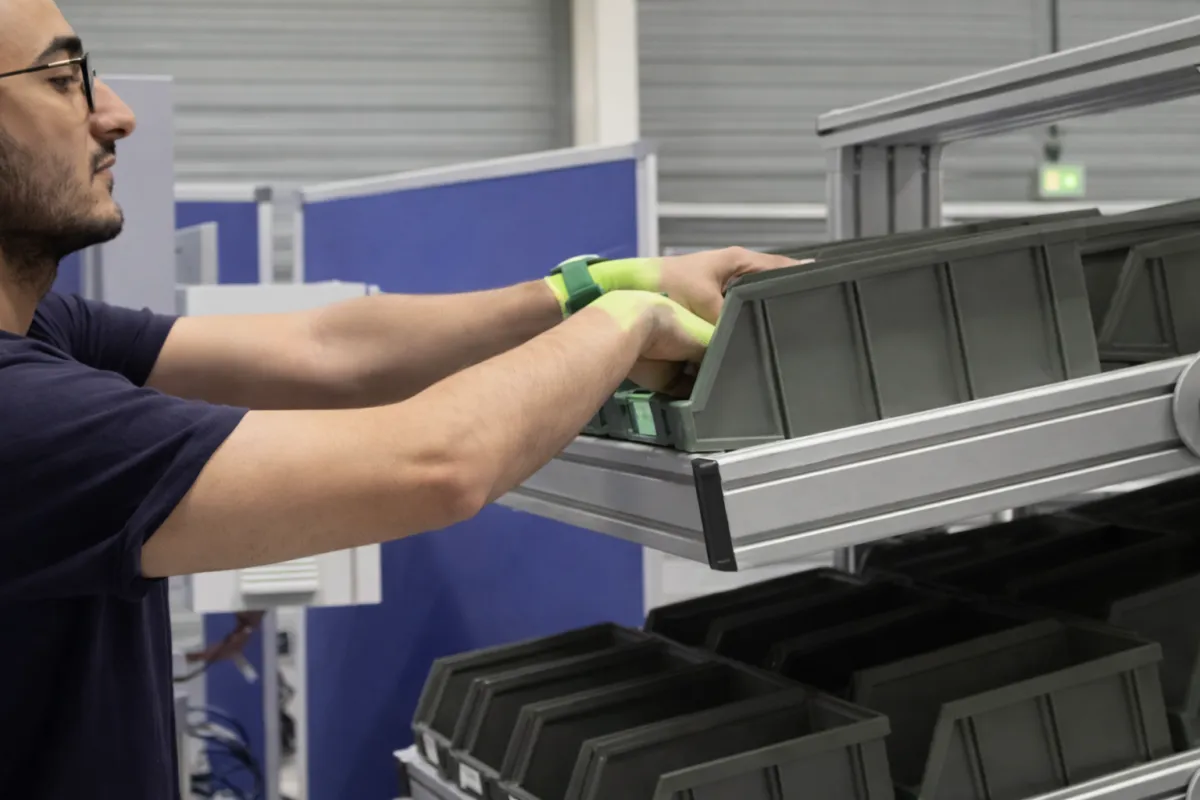
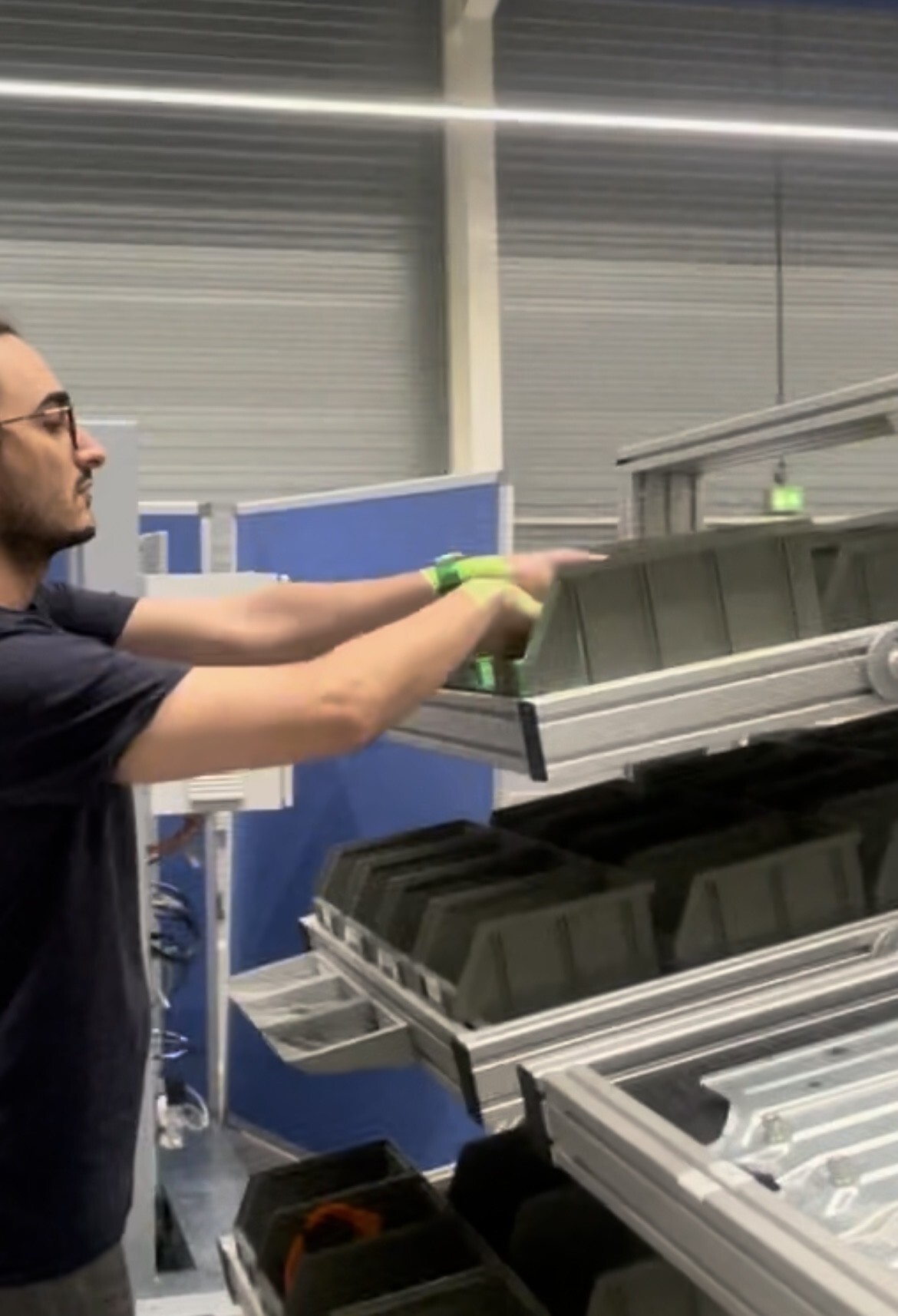
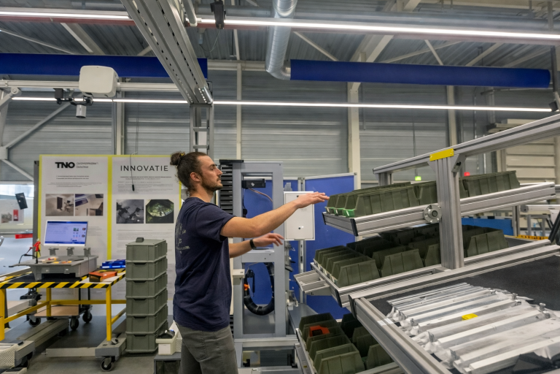
Each kitting cart is equipped with a projector and 3D sensor that highlights the exact bin containing the required component. Operators are visually guided to the correct location, significantly reducing picking errors and eliminating guesswork.
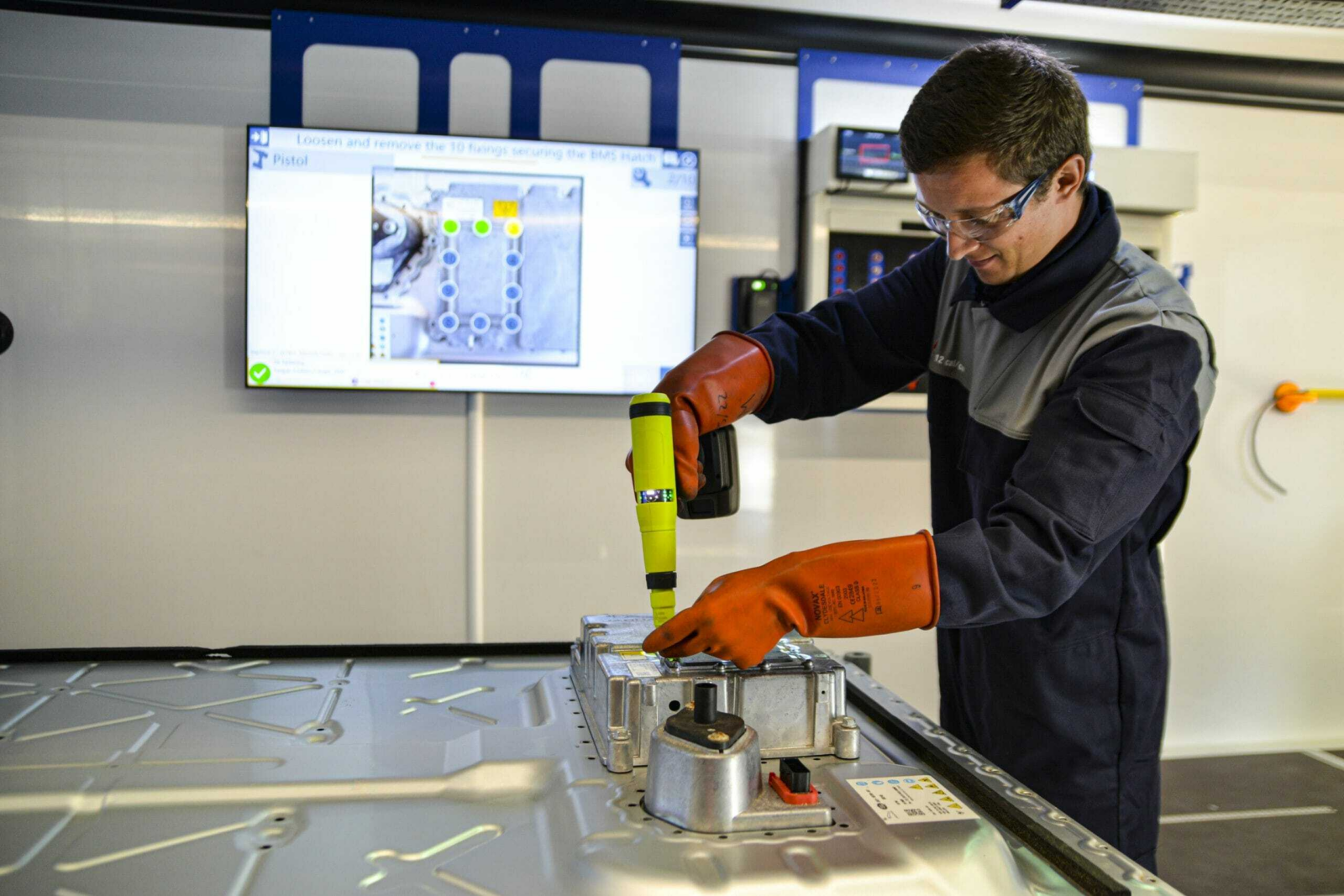
At the assembly workstation, operators receive dynamic digital work instructions that automatically adapt to the specific EV battery or product variant being assembled. This eliminates confusion when producing multiple OEM battery configurations on the same production line.
Integrated machine vision continuously verifies that every operator action has been completed correctly before allowing the process to continue. This no-fault-forward approach prevents assembly errors from moving downstream and improves overall product quality.
To ensure critical assembly operations are performed with maximum precision, the system monitors the position of assembly tools in real time. Operators are guided to the correct location, while tool positioning is verified with an accuracy of less than 5 mm, ensuring components are installed exactly where required and reducing the risk of assembly errors.
Connected fastening tools communicate directly with the Ansomat Operator Guidance platform to ensure the correct tightening strategy is applied for every fastening operation. Torque and angle results are automatically verified and recorded, while protective covers are only released or approved for installation after all fastening operations have been successfully completed. This guarantees complete process compliance, improves traceability, and prevents incomplete or incorrect battery assembly.
Assembly instructions are projected directly onto the work surface, (Augmented Reality) visually indicating where components must be installed and in which sequence. Operators can focus entirely on the assembly task without constantly referring to paper documentation or separate displays.
Component picking from multiple kitting carts and assembly at the main workstation are managed within a single operator guidance platform. This ensures synchronized workflows, standardized processes, complete digital traceability, and consistent assembly quality across every EV battery produced.
Following the implementation of Ansomat Operator Guidance, VDL Nedcar achieved significant operational improvements:
| Before Ansomat | After Ansomat |
| Paper-based work instructions | Interactive digital work instructions |
| Operator-dependent assembly quality | Standardized, guided assembly process |
| Manual component selection | Projector-guided picking with visual confirmation |
| Manual verification of assembly steps | Vision-based process validation |
| Complex product variants managed manually | Automatic product-specific work instructions |
| Limited process traceability | Complete digital process traceability |
| High reliance on operator experience | Consistent results regardless of operator skill level |
| Limited visual guidance at workstations | Real-time projected assembly guidance |
| Higher risk of picking incorrect components | Guided picking from the correct kitting cart and bin |
| Process variation between operators | Standardized first-time-right manufacturing across all operators |
Discover the possibilities of Ansomat