Industry: Automotive Manufacturing
Challenge: Managing high-mix, low-volume production while maintaining quality and reducing operator errors.
Solution: Ansomat Operator Guidance with dynamic digital work instructions, cobot integration, and end-to-end process control.
Results:
Tenneco is one of the world's leading automotive suppliers, employing more than 70,000 people across 270 of manufacturing locations worldwide. At its Sint-Truiden facility, the company produces advanced suspension systems for leading automotive brands while responding to growing demand for customized vehicle configurations.
Modern automotive manufacturing no longer revolves around producing millions of identical products.
Customers expect personalized vehicles with different suspension systems, options and configurations. Manufacturers therefore need to combine the flexibility of custom production with the efficiency of mass production.
This growing production complexity creates several challenges:
Traditional paper work instructions and static HMIs simply cannot keep pace with this dynamic production environment.
To support flexible manufacturing, Tenneco introduced its Operator Independent Monitoring Station (OIMS) concept.
Instead of every operator receiving identical instructions, OIMS adapts the amount of information according to the operator's experience.
This adaptive approach enables training on the job, allowing operators to become productive more quickly while maintaining consistent product quality.
Rather than relying on lengthy classroom training, operators continuously develop their skills within the production process itself.
The Operator Independent Monitoring Stations are powered by the Ansomat Operator Guidance platform.
Instead of displaying static work instructions, the software dynamically adapts the guidance based on both the product configuration and the operator's proficiency.
Each operator receives exactly the information needed to complete the task correctly.
The system provides:
By guiding operators with intuitive visual prompts, the likelihood of assembly mistakes is significantly reduced while production quality remains consistent across all product variants.
Whether an operator is completely new or highly experienced, the system enables them to assemble complex products with confidence.
The increasing number of product variants means production changes occur more frequently than ever before.
Rather than creating separate work instructions for every possible configuration, Ansomat allows reusable production logic to automatically generate the correct assembly sequence.
This provides several advantages:
Production teams can introduce new variants without redesigning the complete assembly process.
Some production stations combine collaborative robots with digital operator guidance.
The cobot positions heavy suspension components while Ansomat provides visual instructions directly to the operator.
This allows operators to focus on value-adding assembly work while repetitive handling tasks are automated.
The result is:
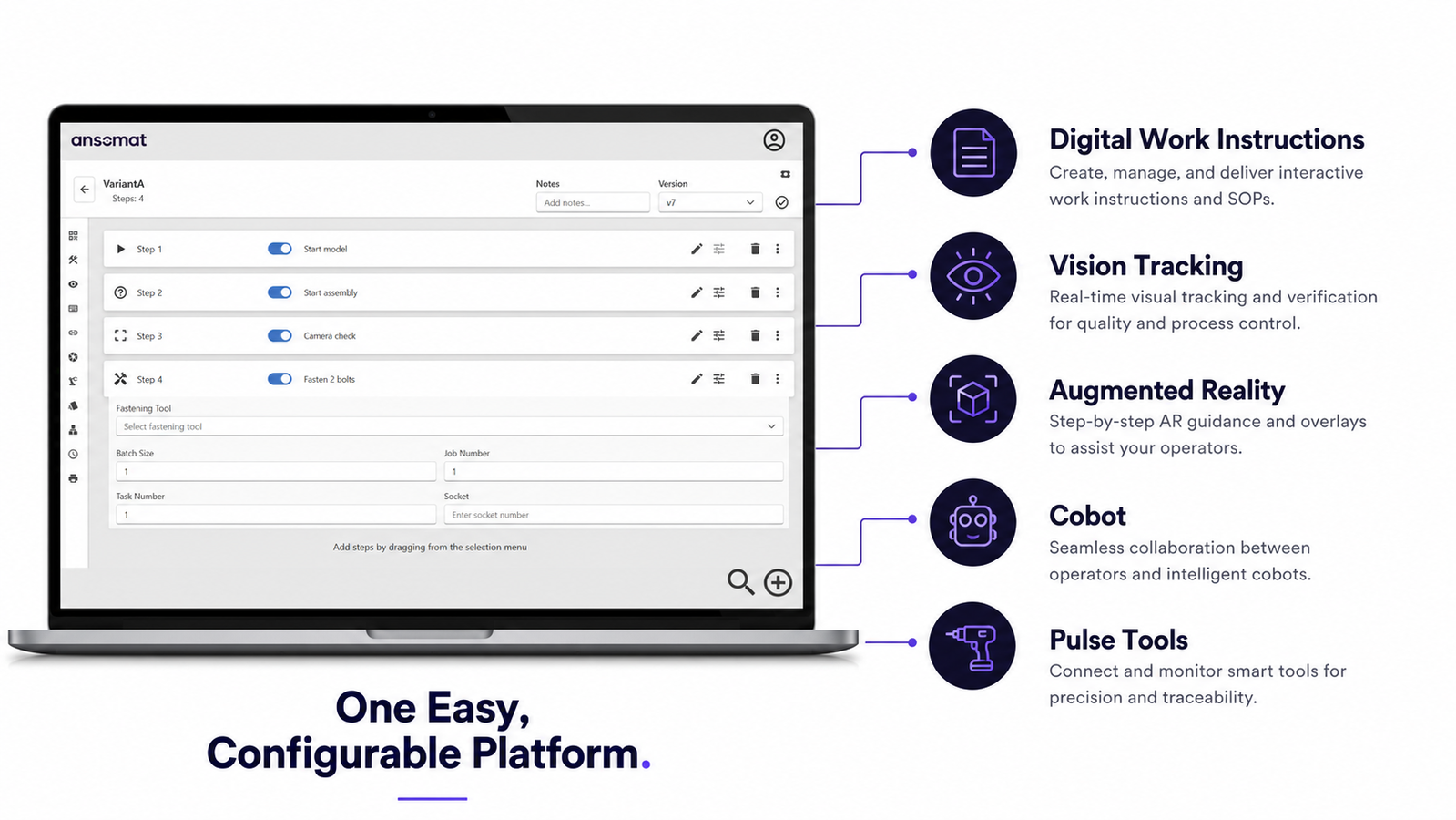
Ansomat coordinates the complete assembly process by connecting digital work instructions with production equipment.
The platform integrates with:
Every workstation automatically receives the correct product data, process parameters and operator instructions, ensuring complete traceability throughout production.
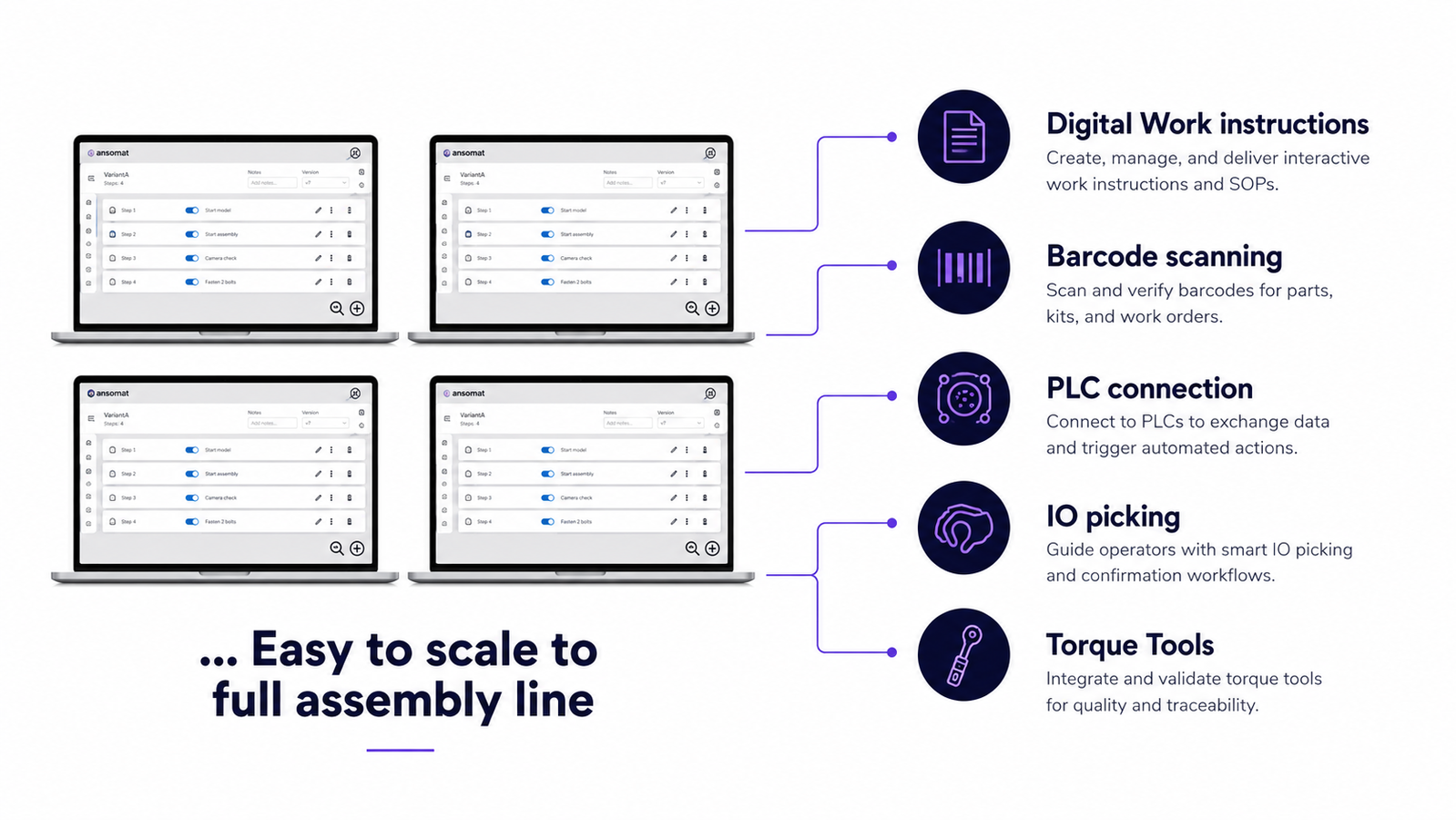


Engineering teams can rapidly adapt production processes without extensive software development.
Using Ansomat they can:
This significantly reduces the effort required to support increasingly complex manufacturing environments.
“The operator just needs to follow the screen and can perform fairly complex processes in no time.” Says Bert Diels. “This is a must as our one-off productions are increasing. It requires little adjustment time for the operator to do a new cycle (whether it is a riveting more or less, valve more or less,…).
Operators benefit from receiving only the information that is relevant for the product they are assembling and their own level of experience.
Key advantages include:
Instead of memorizing hundreds of assembly variants, operators are guided step by step whenever needed.
Bert Diels: “They are fairly open with the system and are smooth with it. “it helps them” is the response. At first it is always difficult to introduce a new system that “controls” them, but after a few hours of working with Ansomat Operator Guidance they accept it and understand that it helps them.”
By combining the Operator Independent Monitoring Station concept with Ansomat Operator Guidance, Tenneco successfully transformed its manual assembly process into a flexible digital production environment.
The solution enables the company to support mass customization while maintaining the quality standards expected by leading automotive manufacturers.
Key results include:
Simplified management of thousands of product variants
| Before | After |
| Growing number of customized suspension variants increased production complexity. | Flexible production supports a high number of product variants without sacrificing efficiency. |
| Every operator received the same work instructions, regardless of experience. | OIMS and Ansomat Operator Guidance adapt instructions to each operator's proficiency level. |
| New operators required extensive supervision and training. | New operators receive detailed, visual step-by-step guidance and learn while working. |
| Experienced operators were slowed down by unnecessary instructions. | Experienced operators can skip familiar steps, maintaining productivity while following standardized processes. |
| One-off production increased the risk of assembly mistakes. | Context-aware operator guidance reduces errors and ensures consistent quality across product variants. |
| Knowledge remained with experienced operators. | Best practices are digitized and available to every operator at every workstation. |
| Frequent product changes required flexible operator support. | Dynamic digital work instructions automatically adapt to changing products and production orders. |
| Maintaining quality became increasingly challenging as product complexity grew. | Operators receive the right information at the right time, helping Tenneco maintain high quality standards even in high-mix, low-volume production. |
As manufacturers continue to move toward mass customization, digital operator guidance has become a critical enabler of flexible production.
Tenneco demonstrates that supporting operators with adaptive, context-aware work instructions allows manufacturers to produce highly customized products efficiently while maintaining consistent quality.
With Ansomat Operator Guidance, every operator receives the right information at the right time, making complex assembly processes simpler, faster and more reliable.
Tenneco's approach demonstrates that increasing product personalization doesn't have to come at the expense of productivity or quality. By combining adaptive operator guidance with digital work instructions, manufacturers can successfully manage high-mix production while empowering operators of every experience level.
If your production team is facing similar challenges—more product variants, longer assembly cycles, or increasing training demands—we'd be happy to show you how Ansomat can help.