Every organization relies on work instructions. The real question is where those instructions live.
In practice, most companies fall into one (or more) of these three buckets:
Each approach gets the job done, to a point. But the differences between them have a huge impact on quality, training, scalability, and resilience.
Let’s take a closer look.
This is the oldest system of all.
Work gets done because someone knows how to do it. Usually a veteran employee. Usually very well. And usually without anything written down.
Why it exists
Where it breaks down
Reality check:
Tribal knowledge feels efficient, until it suddenly isn’t.

The next step up is documenting the work in manuals, binders, or PDFs stored on shared drives.
Why organizations use them
Common limitations
In practice, PDFs often exist to prove a process exists, not to help someone perform it, a challenge explored in more detail in Can PowerPoint Really Work as a Digital Work Instruction Tool?.

Digital work instructions bring guidance directly to the worker, at the moment they need it.
Delivered via tablets, workstations, or mobile devices, they provide step-by-step, visual, and interactive guidance.
Why they work
What changes
Digital work instructions turn “how we do things” into a system, not a dependency on individuals.
Side-by-Side Comparison
| Criteria | In People's Heads | Paper / PDF | Digital Work Instructions |
| Accessibility | Depends on who’s present | Limited, inconvenient | Instant, at point of use |
| Consistency | Low | Medium | High |
| Training speed | Slow | Medium | Fast |
| Update effort | Informal | Manual & slow | Real-time |
| Scalability | Very low | Limited | High |
| Risk level | High | Medium | Low |

Why Most Organizations Use All Three (Whether They Mean To or Not)
Here’s the truth:
Most companies don’t choose one approach, they accumulate all three over time.
The result? Gaps, workarounds, and unnecessary risk.
The Smart Progression
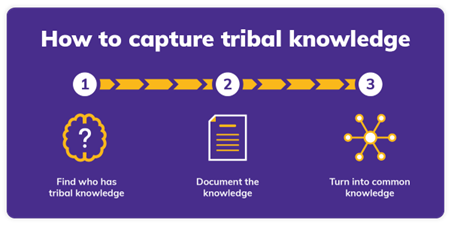
The goal isn’t to eliminate experience or documentation. It’s to capture knowledge before it disappears and make it usable where work actually happens.
A healthy progression looks like this:
Tribal knowledge → Documented process → Digital execution
Experience still matters. SOPs still matter.
But digital work instructions make both actionable.
If you care about quality, training speed, and operational resilience, where your instructions live matters just as much as what they say.