As industries become increasingly connected, reliable communication between devices has become the foundation of modern automation. Whether you're monitoring sensors in a factory, managing energy systems, or connecting thousands of IoT devices across multiple locations, the way machines exchange information matters.
That's where MQTT (Message Queuing Telemetry Transport) comes in.
Today, MQTT has become the industry standard for machine-to-machine (M2M) communication and Industrial IoT (IIoT). Its simplicity, efficiency, and reliability make it the preferred protocol for connecting devices in environments where bandwidth, power consumption, and uptime are critical.
MQTT is a lightweight messaging protocol designed specifically for devices with limited resources and networks that may be unreliable or have limited bandwidth.
Originally developed in 1999 for monitoring oil pipelines over satellite connections, MQTT has evolved into one of the most widely adopted communication protocols for IoT and industrial automation.
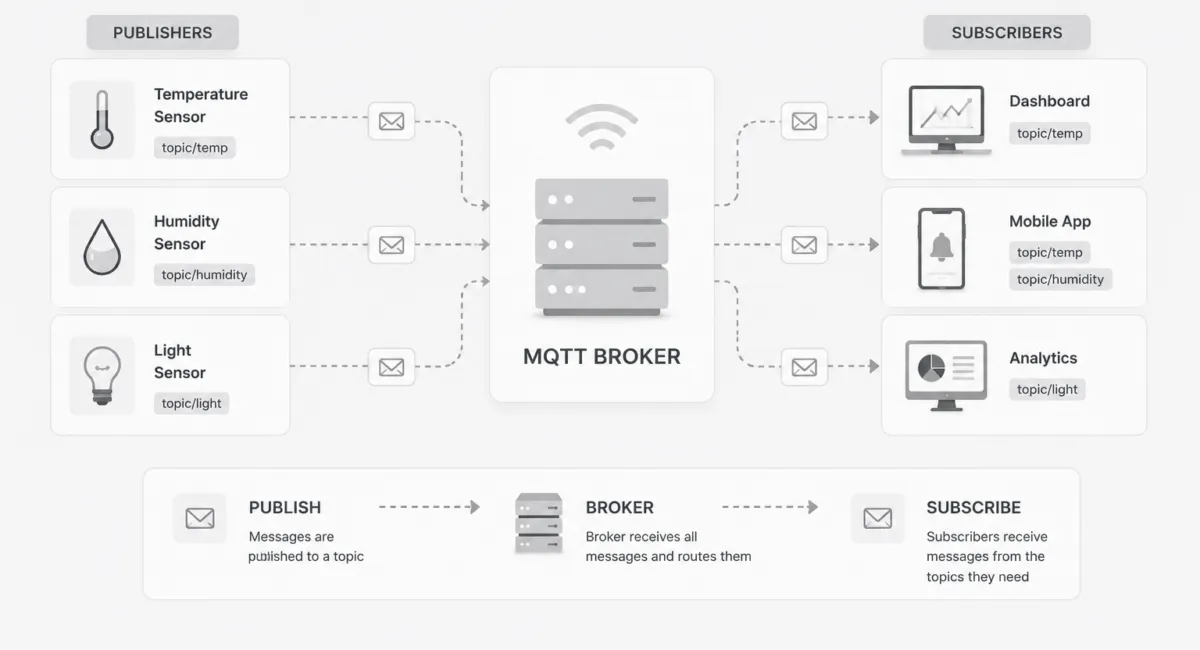
Unlike traditional request-response protocols, MQTT uses a publish-subscribe architecture, allowing devices to exchange information without needing direct connections to one another.
This makes systems more scalable, flexible, and easier to maintain.
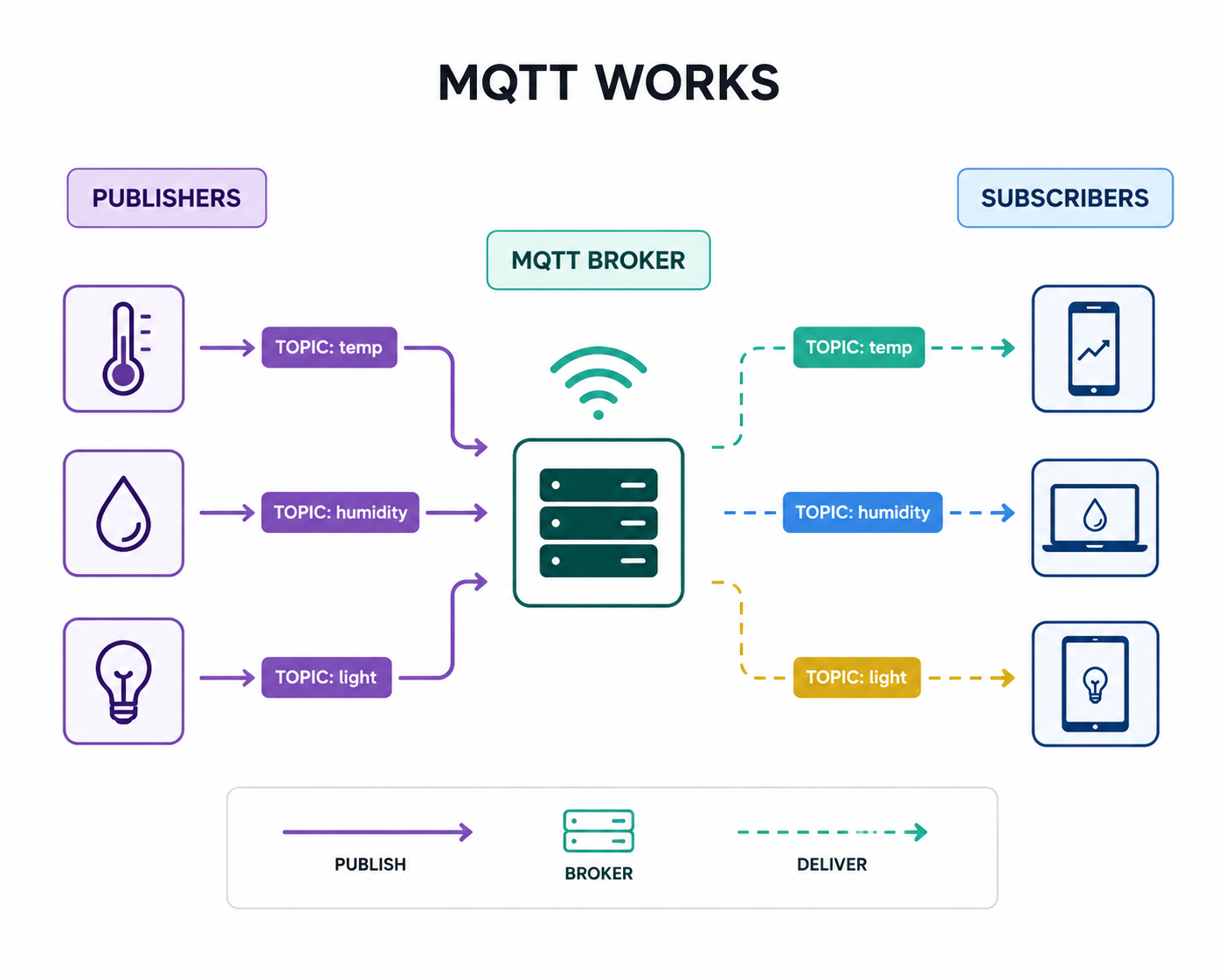
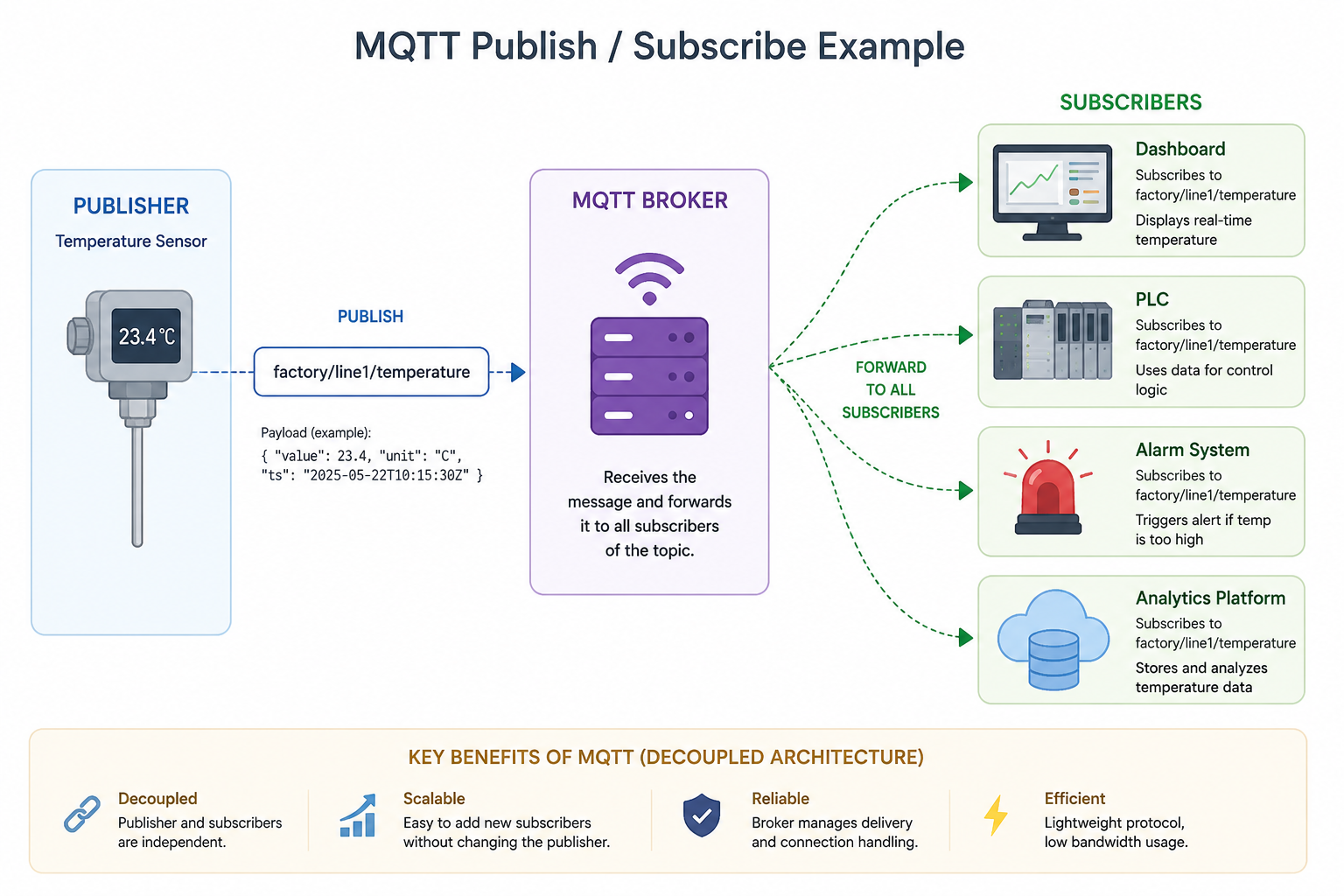
At the heart of MQTT is a broker.
Instead of devices communicating directly:
For example:
A temperature sensor publishes data to:
factory/line1/temperature
A dashboard, PLC, alarm system, and analytics platform can all subscribe to that topic simultaneously.
The sensor doesn't need to know who is listening—it simply publishes the data.
This decoupled architecture makes MQTT incredibly powerful for growing industrial systems.
MQTT messages have a very small overhead compared to protocols like HTTP.
This means:
This is especially valuable for battery-powered sensors and remote installations.
Industrial environments cannot afford lost messages.
MQTT provides three Quality of Service (QoS) levels:
This allows engineers to choose the appropriate balance between speed and reliability depending on the application.
Whether you're connecting:
MQTT scales remarkably well.
Adding new devices usually requires only subscribing or publishing to the correct topics, without modifying existing systems.
MQTT is event-driven.
Instead of continuously polling devices for updates, information is sent immediately when something changes.
This reduces unnecessary network traffic while ensuring dashboards and control systems always receive the latest information.
Modern factories generate enormous amounts of operational data.
PLCs, sensors, HMIs, robots, energy meters, and edge gateways all produce valuable information that can improve production, maintenance, and decision-making.
MQTT provides a common language for these systems.
Typical industrial use cases include:
Because MQTT is vendor-neutral, it also helps bridge the gap between equipment from different manufacturers.
Industry 5.0 relies on connected equipment, continuous data collection, and intelligent analytics.
MQTT enables this transformation by providing a reliable and efficient way for machines to communicate across the factory floor and beyond.
Instead of isolated production cells, manufacturers can create connected ecosystems where data flows seamlessly between operational technology (OT) and information technology (IT).
This opens the door to:
| Feature | MQTT | HTTP | Traditional Polling |
| Communication Model | Publish/Subscribe | Request/Response | Request/Response |
| Bandwidth Usage | ⭐ Very Low | Medium | High |
| Real-Time Updates | ✅ Yes | Limited | ❌ No (Polling Required) |
| Scalable for IoT | ✅ Excellent | Good | Limited |
| Power Consumption | ⭐ Low | Higher | High |
| Network Reliability | ✅ Excellent (QoS) | Good | Depends on Network |
| Ideal For | Industrial IoT, M2M, Smart Factories | Web Applications, APIs | Legacy Systems |
Industrial communication must be secure.
MQTT supports several mechanisms to protect communication, including:
When implemented correctly, MQTT provides a secure foundation for industrial communication across local networks and the cloud.
At Ansomat, we believe industrial data should be accessible, reliable, and actionable.
MQTT aligns perfectly with that vision.
By using MQTT as a communication backbone, industrial systems become easier to integrate, scale, and maintain. Machines, sensors, PLCs, and software platforms can exchange information efficiently, regardless of manufacturer or deployment size.
Whether you're modernizing existing production lines or building a new Industrial IoT solution, MQTT provides the flexibility needed to connect equipment today while remaining ready for tomorrow's innovations.
| Connected Device | MQTT Data | Business Value |
| PLCs | Machine status, cycle times | Real-time production monitoring |
| Sensors | Temperature, pressure, vibration | Condition monitoring & predictive maintenance |
| Test Equipment | Measurement results | Automated quality control |
| RFID Scanners | Product identification | Full traceability |
| Machine HMIs | inputs | Guided workflows |
| MES/ERP Systems | Production events | End-to-end process integration |
| Robots & Machines | Alarms, process states | Faster response and reduced downtime |
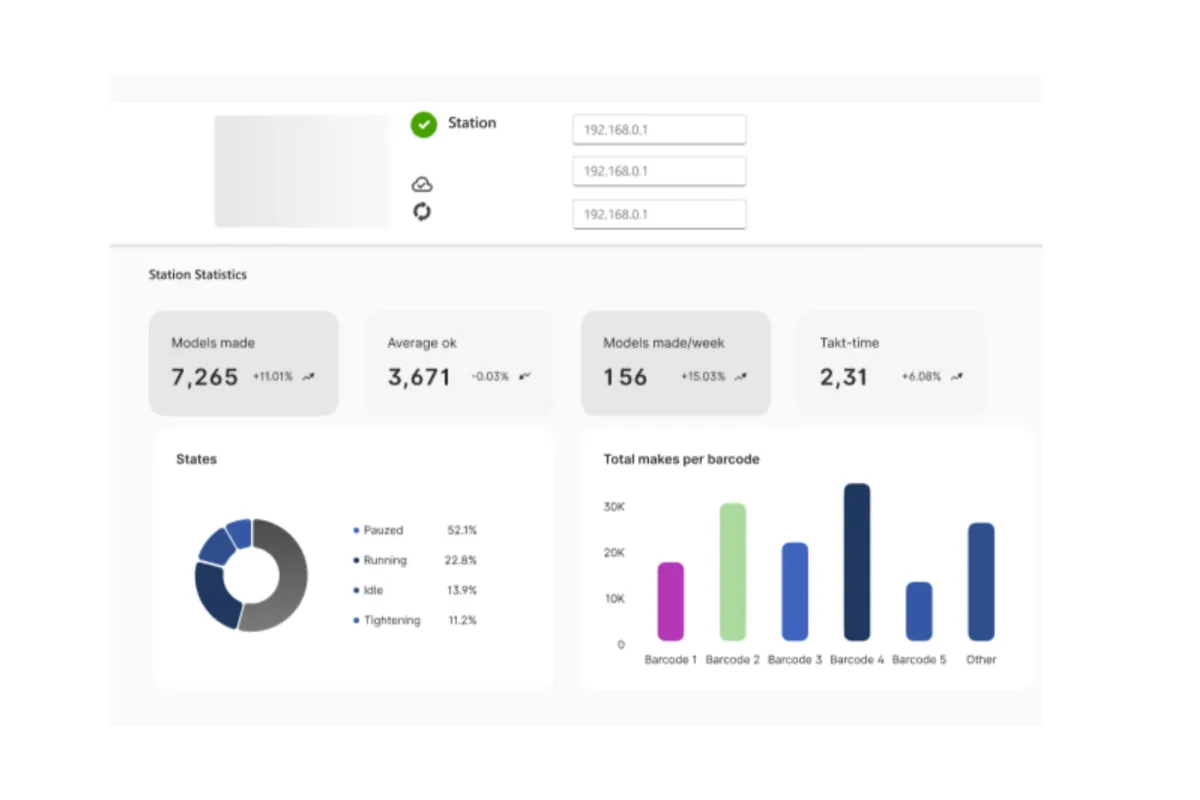
At Ansomat, MQTT is used every day to connect machines, test equipment, PLCs, sensors, and external systems with our Operator Guidance platform. This real-time communication ensures production data, machine states, process values, and quality information are instantly available to operators and engineers.
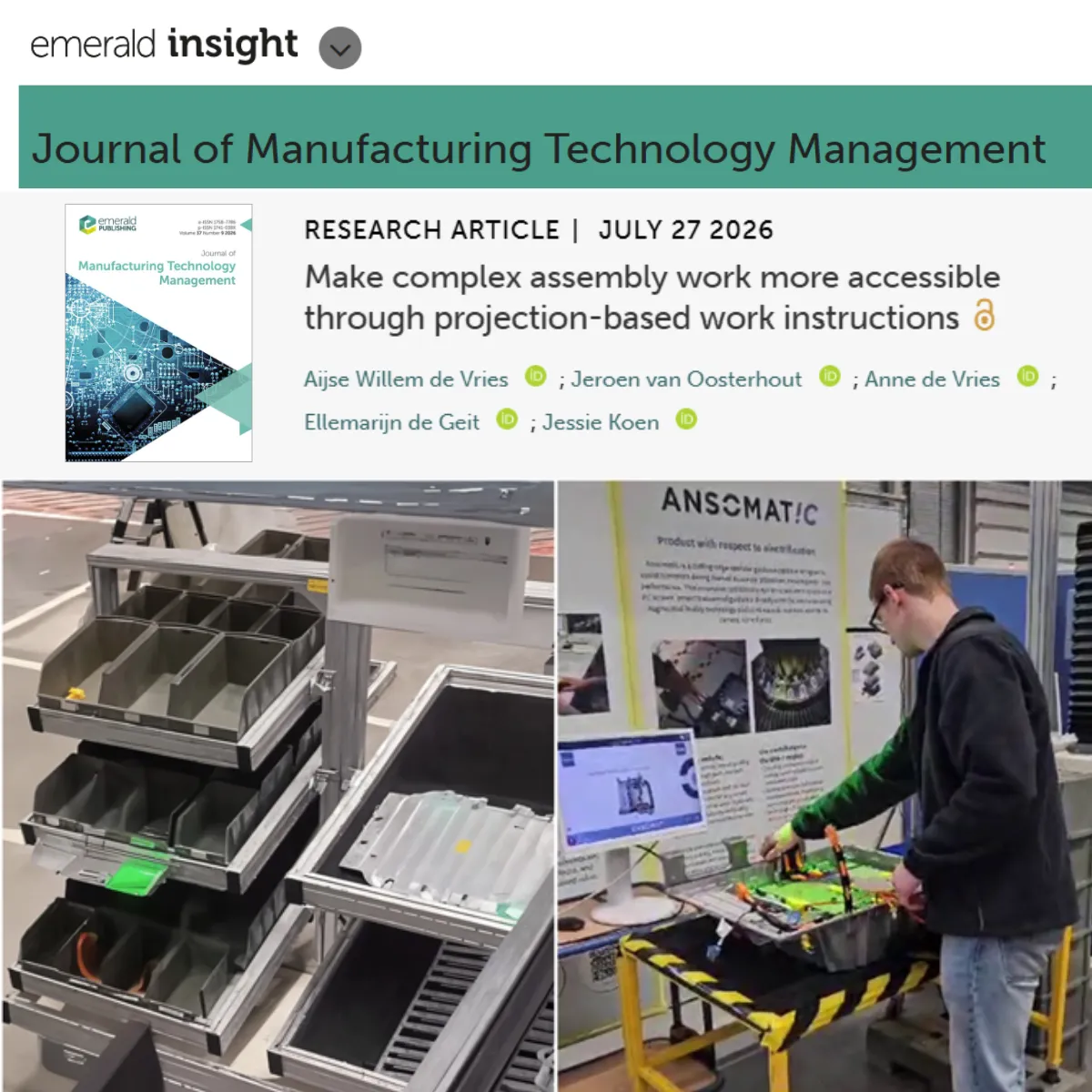
For example, at Autocraft, MQTT connects battery diagnostics, test equipment, and digital repair workflows to support safe, standardized EV battery repair and complete process traceability. Read the full case study: Autocraft EV Battery Repair Case Study. Meanwhile, Zumtobel uses the Ansomat Operator Guidance System to connect manufacturing processes and digital work instructions, significantly reducing defects while providing the flexibility to adapt to changing production requirements. Read more: Zumtobel Customer Reference. Together, these examples demonstrate how MQTT enables seamless connectivity between equipment and operators, creating smarter, more efficient manufacturing environments.
As industrial systems continue to evolve, communication protocols must be efficient, reliable, and scalable.
MQTT has proven itself as the go-to protocol for machine-to-machine communication because it combines lightweight messaging with enterprise-grade reliability and scalability.
For manufacturers embracing digital transformation, MQTT is more than just another protocol—it's the backbone that connects machines, systems, and people, enabling smarter operations and better decision-making.
At Ansomat, we leverage technologies like MQTT to help businesses unlock the full potential of their industrial data, creating connected solutions that are ready for the future.
With Ansomat Operator Guidance, you can seamlessly connect machines, PLCs, sensors, and test equipment, giving operators the right information at the right time while improving quality, traceability, and productivity.