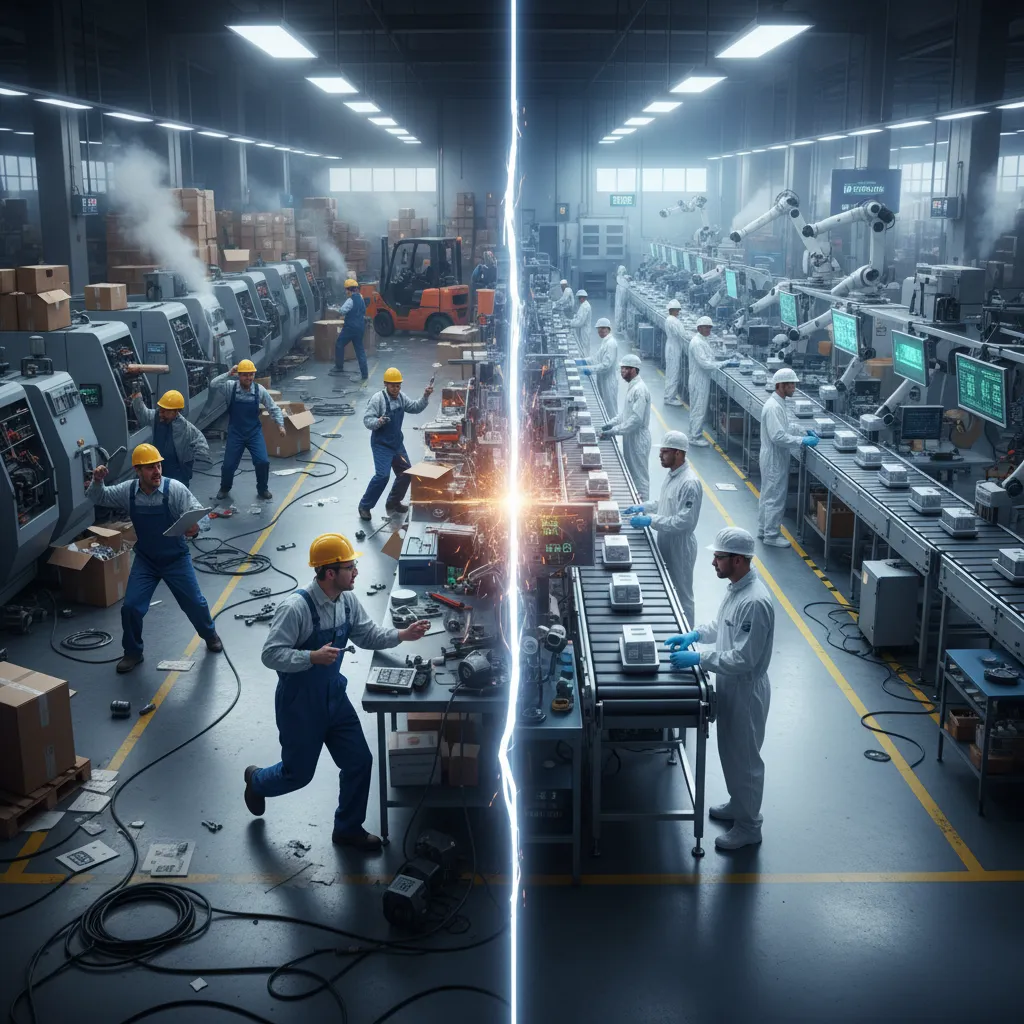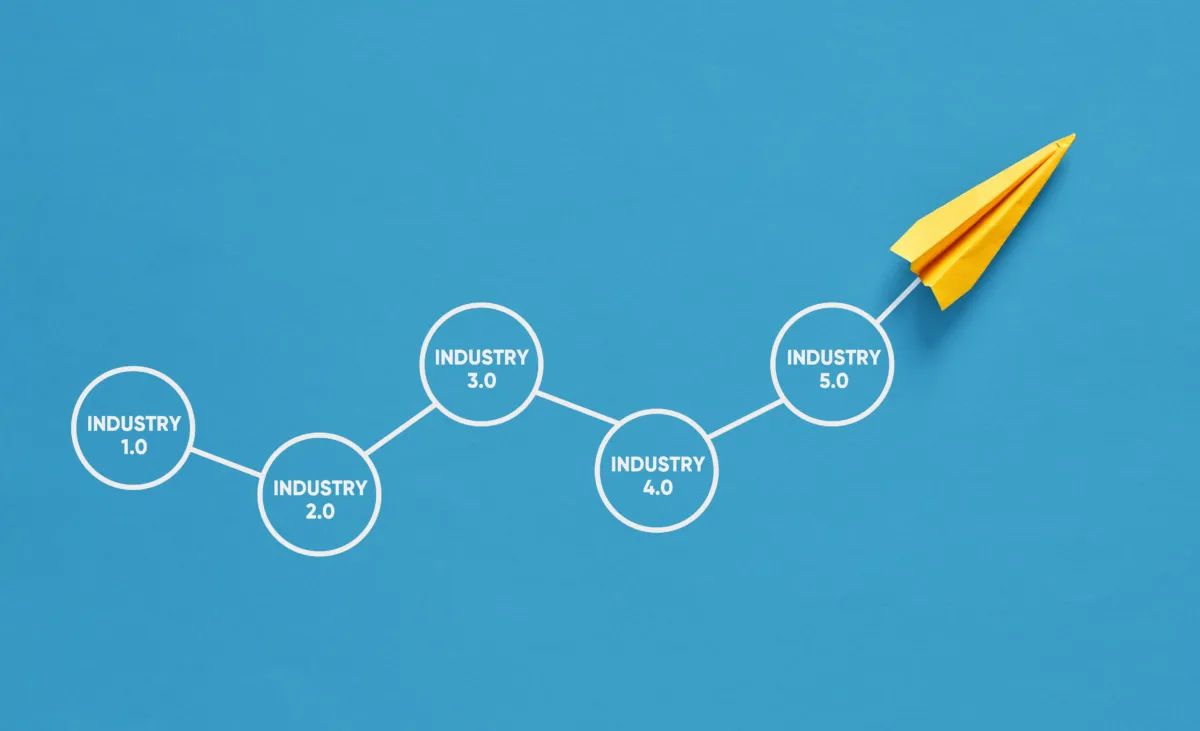
For more than a decade, Industry 4.0 has transformed manufacturing through automation, robotics, machine connectivity, and data-driven production. While these technologies delivered massive efficiency gains, today manufacturers are increasingly reaching the limits of full automation. This is where Industry 5.0 emerges as the next evolution: a shift toward human-centric, flexible, and intelligent manufacturing.
Industry 4.0 was built on the promise of maximum automation. Robots, machines, and software took over repetitive and standardized tasks, allowing factories to run continuously with minimal human intervention. It's key focus is on:
These principles created major productivity improvements, especially in highly automated areas such as paint shops and body shops. However, several structural limitations have become clear:
Rising product complexity and mass customization
Yet today’s manufacturing reality looks different. Products are more customized, product lifecycles are shorter, and variant complexity is rapidly increasing. Every change in configuration or design requires adjustments in production. Reprogramming robots for each new product variant is time-consuming and expensive, making full automation less flexible than originally expected.
The global war for talent
At the same time, manufacturers are facing an unprecedented war for talent. Industrial jobs are increasingly difficult to fill due to shift work, physical strain, and changing career preferences among younger generations. Even when talent is found, employee turnover remains high, turning onboarding and training into a continuous cost factor rather than a long-term investment.
Automation cannot replace human-driven economies
Although artificial intelligence and automation continue to advance, they cannot fully replace the human contribution to manufacturing. From an economic perspective, human labor remains a critical driver of employability, productivity, and national welfare. For many regions around the world, human-driven manufacturing is still the backbone of their economy. Removing this element would not only be unrealistic, but socially and economically devastating.
For more than a decade, Industry 4.0 has shaped modern manufacturing through automation, robotics, and machine connectivity. Fully automated lines, data-driven production, and 24/7 operations have created enormous efficiency gains across many industries. However, as products become more complex and customer demand shifts toward personalization, the limits of full automation are becoming increasingly visible.
This transition marks the rise of Industry 5.0, a new era in which humans are no longer replaced by technology, but empowered by it. Industry 5.0 focuses on human-centric production, where flexibility, ergonomics, and intelligence on the shop floor become just as important as speed and output.
Traditional work instructions in manufacturing still rely heavily on paper or static PDF files. These documents are difficult to search, rarely updated in real time, and often ignored on the shop floor. As a result, operators rely on memory or informal knowledge transfer, which increases error rates and frustrates process engineers.
Digital work instructions change this paradigm completely. They guide operators through each task step by step using dynamic, interactive content. Instructions can be adjusted based on the operator’s skill level, ensuring that beginners receive detailed guidance while experienced operators are not slowed down by unnecessary information. When an employee returns after a longer absence, the system can automatically refresh their knowledge based on historical performance data.
Key benefits:
Digital work instructions are the foundation of human-centric production in Industry 5.0.
Globalization has transformed the workforce into a multicultural environment where language diversity is the norm rather than the exception. When operators are forced to work in a non-native language, productivity drops and mistakes increase.
Key benefits:
Modern digital work instruction platforms translate content in real time per user.
One of the most powerful enablers of Industry 5.0 is projection-based augmented reality. AR work instructions overlay digital information directly onto the physical workspace, allowing operators to see exactly what needs to be done, where it needs to be done, and in which sequence.
Capabilities include:
Augmented reality manufacturing enables complex manual work with machine-level precision.
In Industry 5.0, quality assurance is no longer a separate process carried out after production. Through machine vision integration, quality becomes a real-time companion to human work.
Core functions:
Machine vision transforms quality assurance into a real-time, closed-loop process.
Real-time location systems add a new layer of intelligence to human-centric manufacturing. By tracking movements with extreme precision, these systems make it possible to analyze how operators interact with tools, workstations, and materials.
Use cases include:
In Industry 5.0, human actions become measurable production data.Real-Time Location Systems (RTLS)
For decades, manufacturers have been able to monitor machine performance down to milliseconds, yet human performance remained largely invisible. Human performance traceability changes this by recording each step executed by an operator through digital work instruction platforms.
This enables:
Human performance becomes as transparent and measurable as machine performance.
Industry 4.0 has brought automation and efficiency. Industry 5.0 brings balance. It combines the power of intelligent systems with the adaptability, creativity, and responsibility of human operators.
Technologies such as digital work instructions, AR work instructions, and augmented reality manufacturing do not eliminate human labor, they make it more reliable, safer, and more productive. They allow manufacturers to achieve flexibility without sacrificing quality, and speed without losing control.
The factory of the future is not a dark, fully automated facility. It is a human, centric, digitally enabled environment where people and technology work together seamlessly.
Industry 5.0 is not about replacing the human. It is about building technology that finally works for the human.