Digital operator guidance and connected worker platforms are no longer nice, to, have technologies.
In industries such as automotive, aerospace, white goods, and high, mix, low, volume manufacturing, they are quickly becoming a prerequisite to remain competitive, compliant, and resilient.
Yet one key question often blocks progress:
How do you build a solid business case, one that goes beyond buzzwords and clearly proves value?
This guide walks you step by step through a practical, proven checklist:
from understanding your current situation, to identifying the right use case, quantifying savings, and defining a realistic pilot with fast payback.
Many manufacturers instinctively associate efficiency improvements with automation:
robots, AGVs, fully automated machines.
What’s often overlooked is that human, centric technology, such as digital work instructions and connected worker platforms, can unlock major efficiency gains at a fraction of the cost and risk.
Fully automated initiatives:
Human, centric solutions:
The key is a solid understanding of the AS, IS and TO, BE situation, and a focused rollout strategy.

A strong business case always starts with an honest assessment of today.
Ask yourself:
Does the process include:
How standardized is the setup?
In environments like aerospace, where variability is high and documentation is complex, operator guidance delivers immediate value by reducing ambiguity and inconsistency.
Not every process needs the same level of intelligence.
Key questions:
This analysis defines whether you are dealing with:

You have quantifiable savings. Savings that you can quantify and calculate. These are of course the most convincing ones. But also you have non , quantifiable savings that are more linked to HR and well, being not coming to the surface straight away but overall will lead to better place to work.
Mistakes are expensive, often far more than organizations realize.
Cost formula:
| Number of defective products per month × Average cost per mistake |
Example:
Yearly loss: €1.8 million
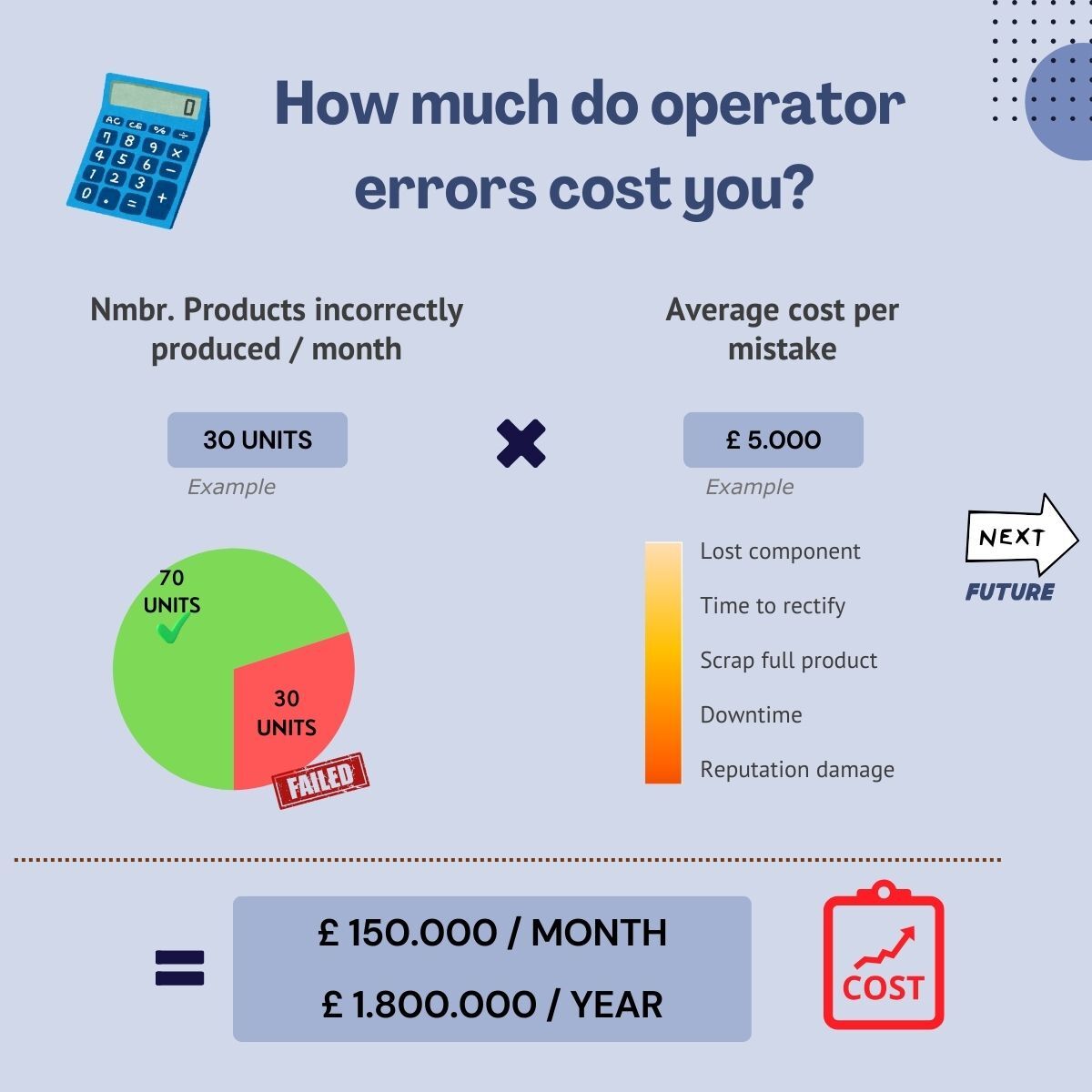
What Defines the “Cost of a Mistake”?
he actual cost depends heavily on severity and risk:
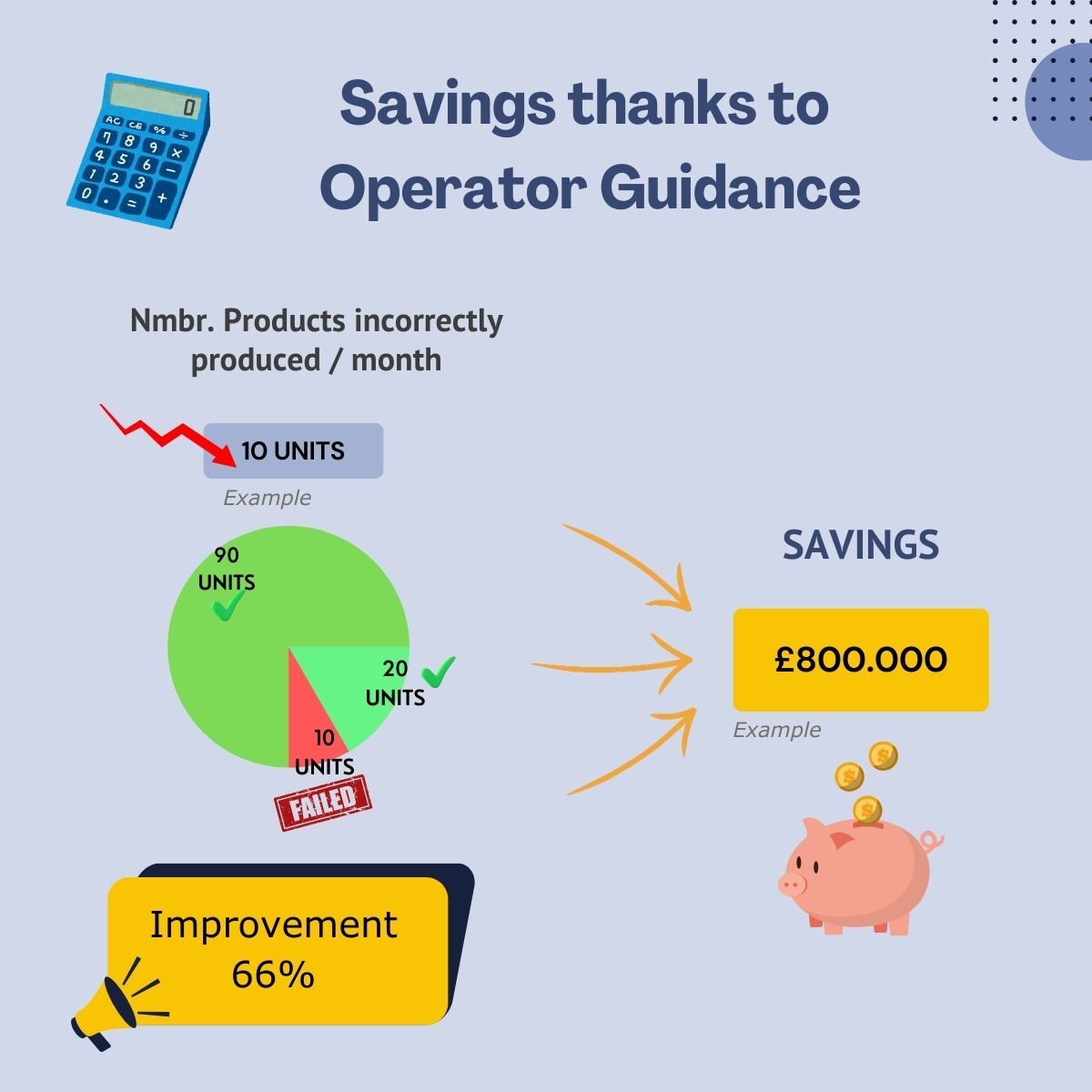
Impact of Digital Work Instructions and Quality Checks
With digital work instructions combined with integrated quality controls, a 66% reduction in mistakes is a realistic and conservative assumption.
In our example, this results in:
Yearly savings: €800,000
Actual savings depend on the number and type of control points implemented.
Doing the Right Thing vs. Doing It Right
Digital work instructions help operators do the right thing by guiding them step by step.
However, instructions alone do not always guarantee correct execution.
That’s where smart, connected devices, such as torque tools, cameras, scanners, or positioning systems, act as an external “guardian angel”:
While these devices add incremental cost, they dramatically improve quality outcomes.
Some manufacturers now validate every single part, achieving first, time, right rates of 99%, compared to significantly lower levels before.
Manufacturers across industries have already realized substantial savings by combining digital work instructions with connected quality controls, including:
Training is one of the largest, and most underestimated, cost drivers in manufacturing and of a connected worker platform.
In many shopfloor environments, workforce rotation is high. Operators often require months of training before they can work independently, yet many leave shortly after becoming productive. Even small wage differences elsewhere can lead to high attrition, making training feel like a recurring cost with limited return.
The impact goes beyond new hires:
All of this reduces productive time and increases operational pressure.
How to Calculate Training Costs
Training cost formula:
| Number of training days × (Daily cost of operator + Daily cost of trainer) × Number of new hires |
Example:


Impact of Digital Operator Guidance
With digital work instructions, standardized processes, and on, the, job guidance, operators learn faster and become productive sooner.
Typical results include:
Yearly training cost savings (example):
€156,000 per year
Why Operator Guidance Makes the Difference
Effective operator guidance:
For organizations struggling with workforce rotation, digital operator guidance is not just a productivity tool, it’s a retention and resilience strategy.
A paperless factory is no longer just a sustainability initiative, it is a key driver of efficiency, quality, and compliance in modern manufacturing.
Paper, based work instructions may appear inexpensive, but their hidden costs quickly accumulate and directly impact productivity, quality, and audit readiness.
The True Cost of Paper in a Paperless Factory Transition
In a traditional paper, based factory, costs extend far beyond printing:
In regulated industries, paper, based processes also increase the risk of non, compliance, as it becomes difficult to prove that operators were working with the latest approved instructions.
Quantifying Paper Reduction in a Paperless Factory
While a single printed page may cost only a few cents, a paperless factory eliminates costs at scale by removing:
Manufacturers transitioning to a paperless factory typically achieve:
Clear, step, by, step digital guidance reduces the mental effort required to perform complex tasks.
Operators no longer need to:
This results in:
An operator who needs to “think less about what to do” can focus more on doing it right.
Connected work instruction platforms enable operators to provide feedback in context and in real time.
Instead of:
Feedback is:
This allows process engineers and quality teams to:
Operators feel heard, and improvements are implemented where they matter most.
operators can give more easily feedback that is consolidated in one central database accessible for the process engineers and their voice and feedback can be much easier implemented
Traceability alone is rarely the business case, but it is the enabler of every future improvement initiative.
A connected work instruction platform creates:
This provides:
Many inefficiencies remain invisible until data exists.
Or as it’s often said:
“You don’t know what you don’t know.”
In many factories, critical knowledge lives in the heads of a few experienced operators.
When they:
Productivity and quality suffer.
Digital work instructions:
This dramatically reduces operational risk and increases organizational resilience.
5. Faster Change Management & Engineering Agility
Process changes are inevitable, but paper, based updates are slow and error, prone.
With connected work instructions:
This enables:
Building a business case for a connected worker platform is not about chasing digital trends, it’s about solving real operational problems with measurable outcomes. By starting with a clear understanding of your current situation, prioritizing human, centric technology, and focusing on high, impact use cases, manufacturers can unlock rapid value without the risk and complexity of full automation.
Quantifiable benefits such as improved quality, reduced training time, and paper elimination often deliver payback in under six months, while non, quantifiable gains, employee confidence, knowledge retention, traceability, and engineering agility, create the foundation for long, term resilience and continuous improvement. Together, these benefits transform digital work instructions from a standalone tool into a strategic platform that scales across lines, plants, and regions.
The most successful organizations start small, prove value quickly, and then expand with confidence. A connected worker platform is not the end goal, it is the enabler that helps your workforce perform better every day, while preparing your factory for the challenges ahead.