


Augmented reality is becoming increasingly prominent across the automotive industry, particularly on the production floor. What once began as a futuristic concept is now a practical solution being adopted to enhance quality, efficiency, and precision in day-to-day operations. From training new operators to guiding complex assembly tasks, AR automotive is transforming how automotive manufacturers work.
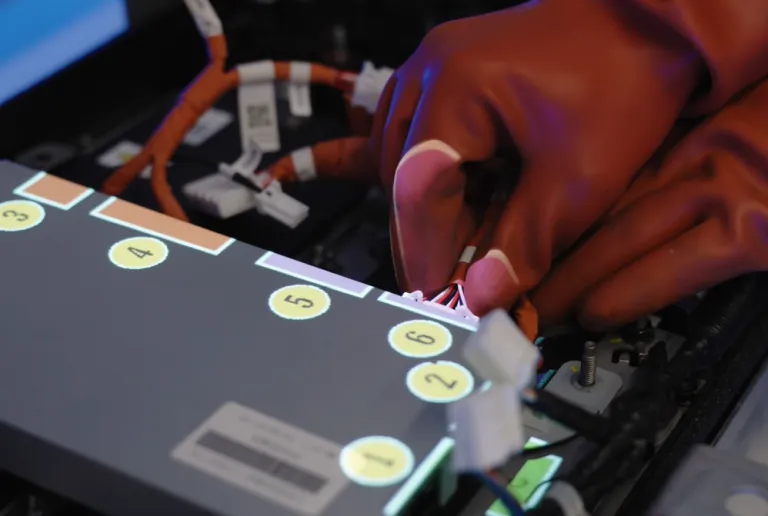


Augmented reality was first introduced as a training tool in automotive sector to prepare operators before they began working on the production floor. This early use of AR allowed trainees to explore tasks in a simulated environment, with instructions projected directly onto the work area. Often combined with vr headsets, this method helped reduce the burden on trainers and provided a self-paced learning experience. While VR headsets are ideal for short-term training, they are less suited for production, as operators prefer not to wear headgear for extended periods.
The first major adoption of AR in automotive began in training departments. It has since proven valuable not only for onboarding new hires but also for helping experienced operators refresh their skills, such as after returning from vacation, using AR systems in dedicated training rooms.
Projection-based AR is currently the most embedded and sustainable form of augmented reality used in live production environments. This technology utilizes projectors to display visual cues; such as text, images, or videos,… directly onto the workstation, guiding operators step by stepduring the assembly process in real time.
There are several reasons why projection-based AR is more embedded and effective compared to wearable solutions:
Despite rapid growth in electric vehicle technologies, many manufacturers face challenges in automating complex engine assembly processes. Operator guidance systems with AR automotive are ideal in these cases, providing visual step by step instructions projected in real time.
Machine vision systems enhance accuracy by verifying each task and providing instant feedback when errors occur. These systems also support precise position monitoring, down to 1.5 millimeters, which is critical for tasks like controlled tightening sequences.
Eventually, every step in the process is logged for enhanced traceability. This way you have full transparency and all the data of what has happened during the critical assembly of an engine

The battery system is a vital component in electric vehicles, and ensuring OEM level quality is a top priority. AR powered operator guidance technologies combine human flexibility with machine level precision, offering the best of both worlds. Features include DC tooling for validating torque and angle during fastening, integrated vision systems that prevent incorrect part selection, and full sequence control.
All critical actions are logged, creating a digital DNA for each component. These systems support single item batch assembly, automatically loading the correct program and tools for each new task without manual setup.
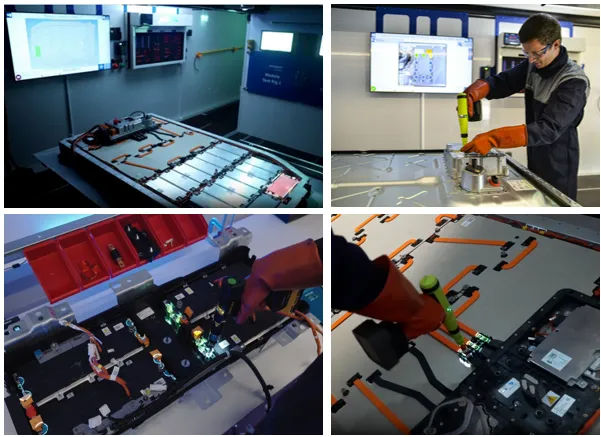
Hydrogen fuel cell production is still emerging for many manufacturers and involves high precision tasks. AR based operator guidance plays a critical role by reducing errors and increasing compliance with strict quality standards.
Instructions are displayed in real time on large screens at the workstation, while integrated validation technologies such as vision systems and tool position tracking ensure every action is performed correctly. All operator steps are recorded, providing complete traceability for every assembly cycle.

Errorproof manual processes to the hightest degree
Standard work with AR creates a reliable baseline for everyone, no matter who is performing the task. This eliminates variability and leads to more stable, repeatable outcomes.
In combination with vision, it’s the ultimate process guidance for zero defects manufacturing. Operators just need to “follow the lights”, and as a result work faster and smarter.
Rather than pulling operators into artificial classrooms, manufacturers can organize training right on the shopfloor. The benefits are huge: learner confidence is increased, new processes are successfully executed, operators need less supervision and training time is drastically reduced.
People are visual learners. Visuals are universal and tell more than a thousand words. On top, visual information sticks better as graphics draw the attention. Thanks to AR automotive complex tasks become more comprehensive and accessible to anyone.

To conclude, augmented reality is steadily reshaping the automotive industry by bridging the gap between manual labor and digital precision. What began as a training tool has evolved into a powerful solution for real-time operator guidance on the production floor. Projection-based AR, in particular, has proven to be the most practical and widely adopted form, offering hands-free, intuitive support without disrupting workflow. From engine assembly to EV battery and hydrogen fuel cell production, AR ensures consistent quality, reduces errors, and increases efficiency. As automotive manufacturing continues to evolve, augmented reality will remain a key enabler of smarter, safer, and more agile production environments.
For organizations committed to lean principles, operational excellence, and future-ready production, digital work instructions are an essential tool in the toolbox.


