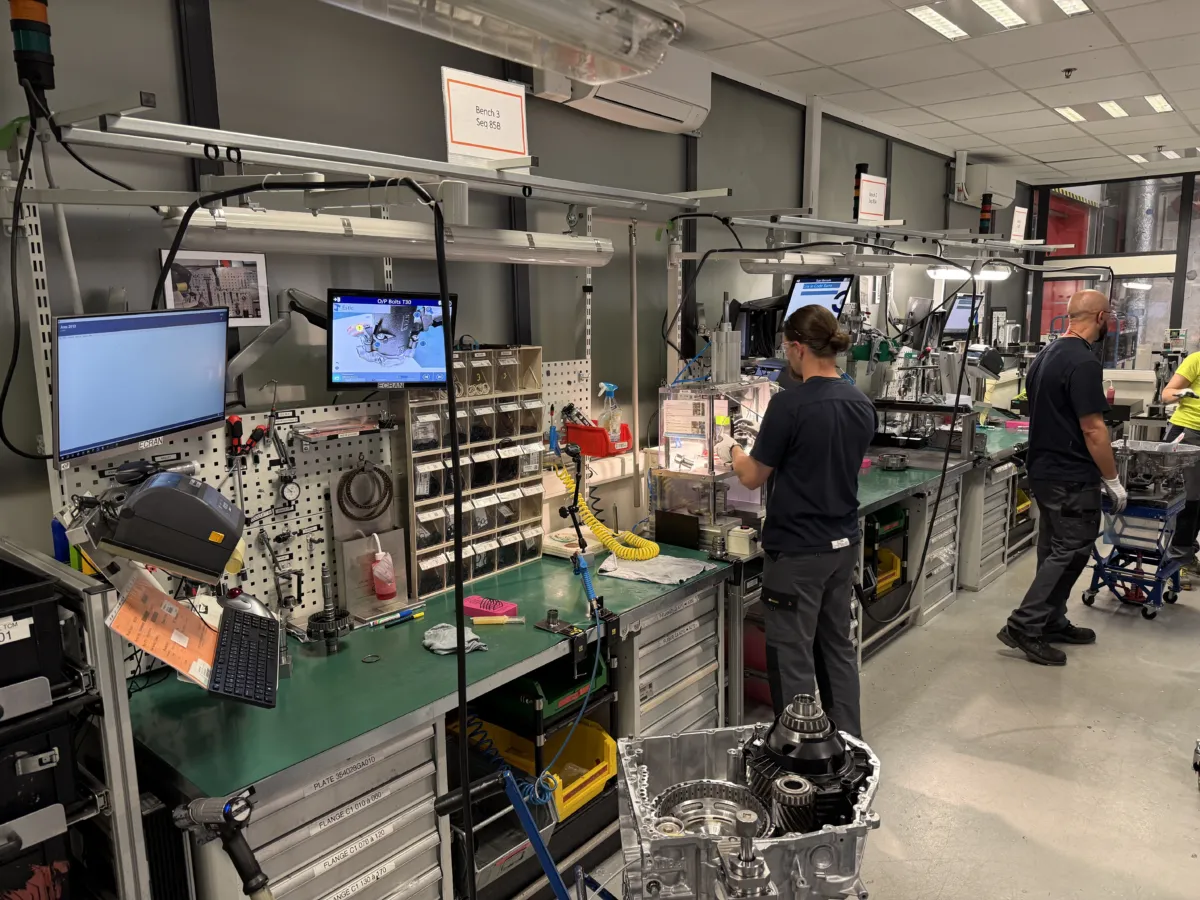
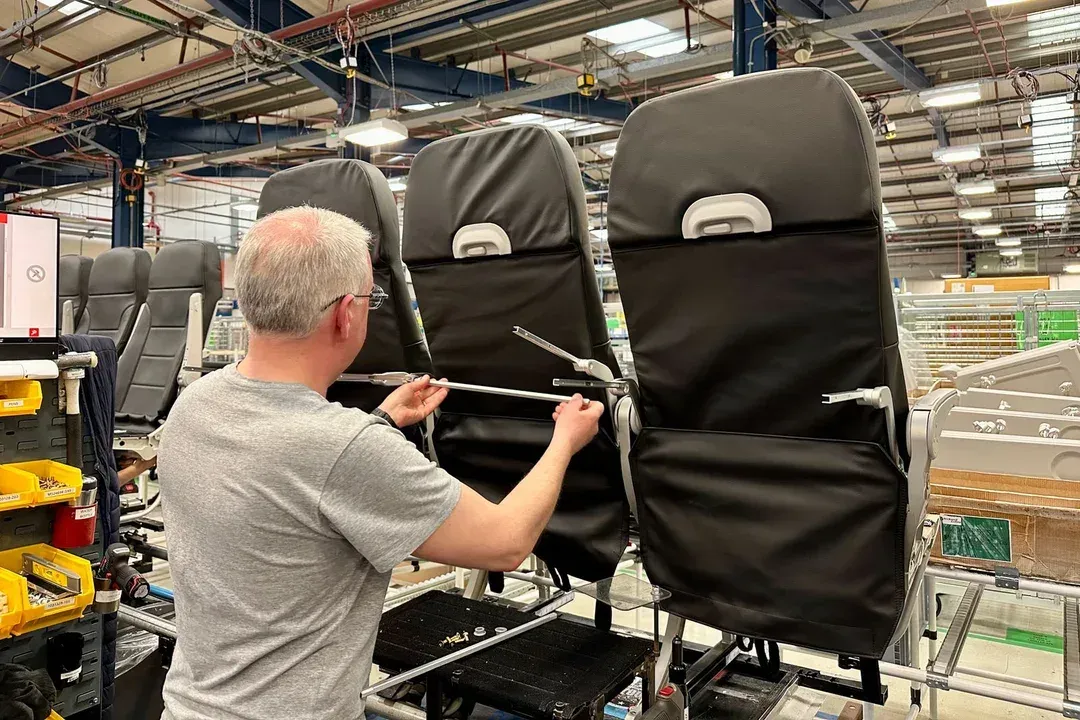
Industrial tightening requires more than achieving the correct torque. Operators need to work safely and comfortably, while manufacturers need repeatable fastening quality and complete process traceability.
ESTIC combines these requirements in one fastening platform.
Its electric pulse technology reduces the reaction force transferred to the operator while maintaining precise control of the fastening process. Available in both corded and cordless pulse tools, ESTIC fastening tools provide torque and angle monitoring, production data and industrial communication for demanding assembly environments.
Assembly workers using handheld powered tightening tools can be repeatedly exposed to reaction loads.
With a conventional direct-drive tool, the motor is directly connected to the output shaft. As the fastener reaches its target torque, the reaction generated by the tool has to be absorbed by the operator or by a reaction device.
The amount of reaction an operator can comfortably handle also depends heavily on the tool configuration. As a practical guideline:
| Tool configuration | Reaction-force guideline |
| Straight tool | ~2 Nm |
| Pistol tool | ~10 Nm |
| Angle tool | ~50 Nm |
Above these levels, a suitable reaction device should be considered for conventional direct-drive applications.
But adding reaction arms and other mechanical devices can restrict tool accessibility and operator movement.
ESTIC approaches the problem differently: reduce the reaction force generated during the fastening process itself.
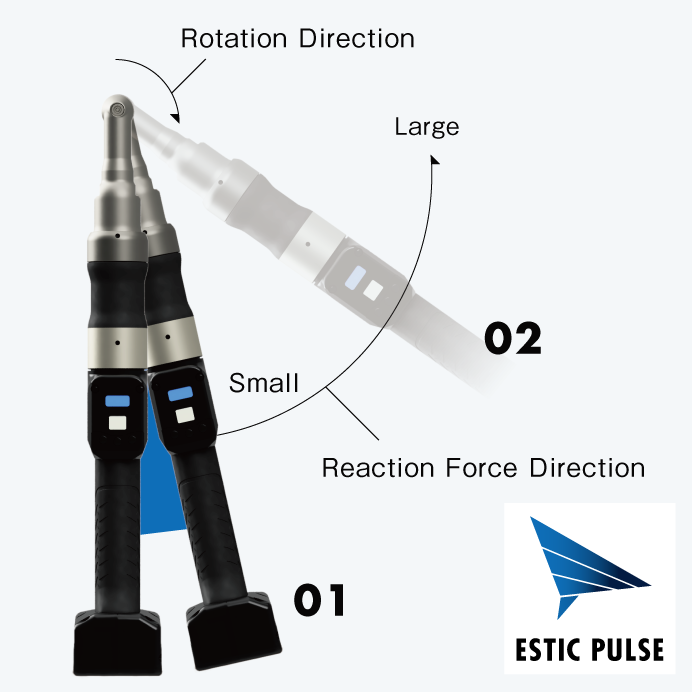
ESTIC's patented pulse technology is designed to minimize reaction force during tightening.
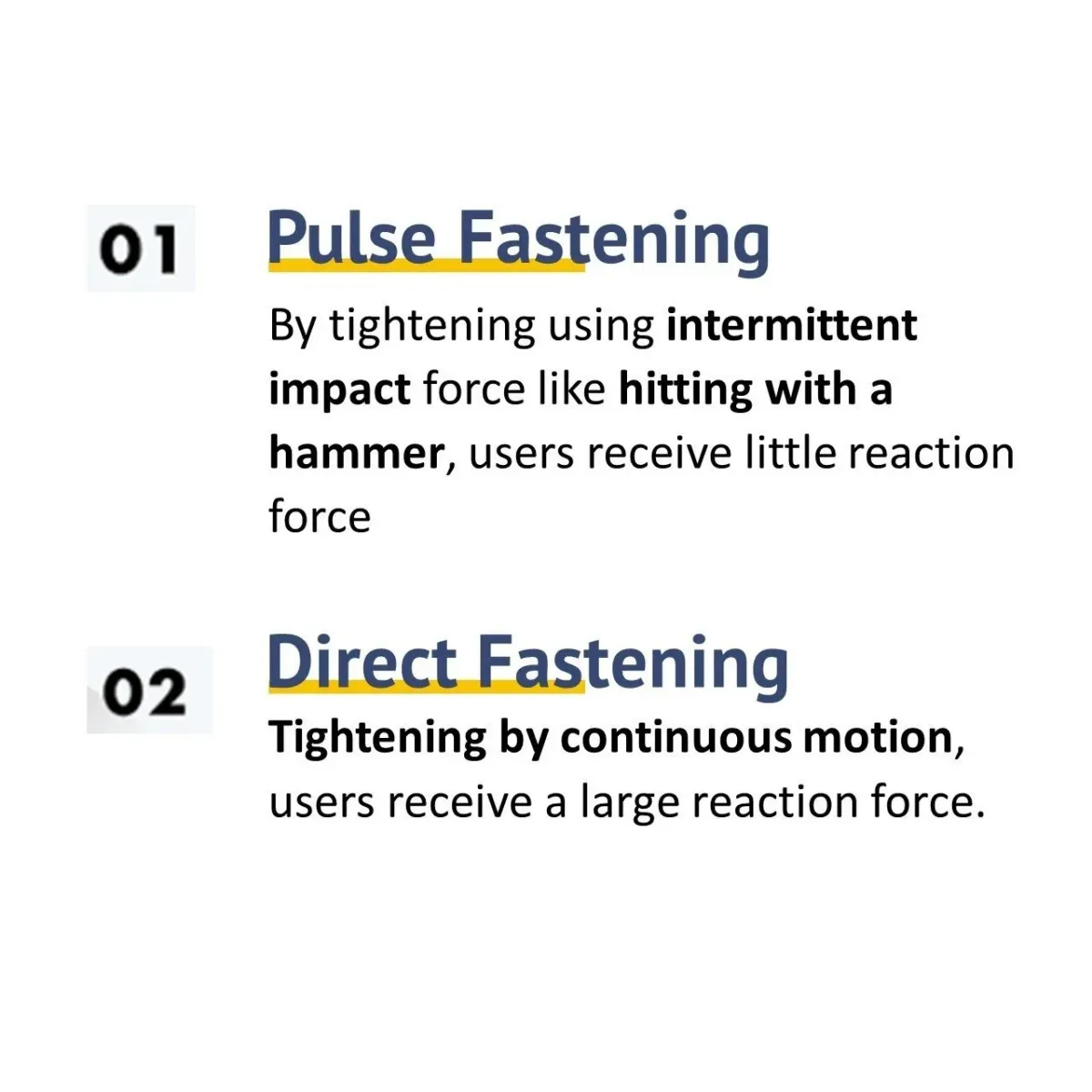
Instead of reaching the final torque through continuous rotary force, ESTIC Pulse applies torque intermittently. The operator therefore receives considerably less reaction force during the fastening process.
ESTIC combines this principle with its proprietary motor-control technology. Torque data is continuously processed every 1/2000 of a second to control fastening strength and deliver accurate tightening with minimal reaction force.
Pulse fastening
Torque is delivered through intermittent force—similar to repeated hammering. The operator receives relatively little reaction force.
Direct fastening
Torque is delivered through continuous rotation. As the tool tightens the fastener, the operator receives a much larger reaction force.
This distinction is at the heart of ESTIC's approach to ergonomic handheld fastening.
The result is a fastening solution that can reduce physical strain while retaining the process control required for industrial production. ESTIC states that the combination of its ergonomic design and pulse technology can even enable single-handed operation in certain situations.
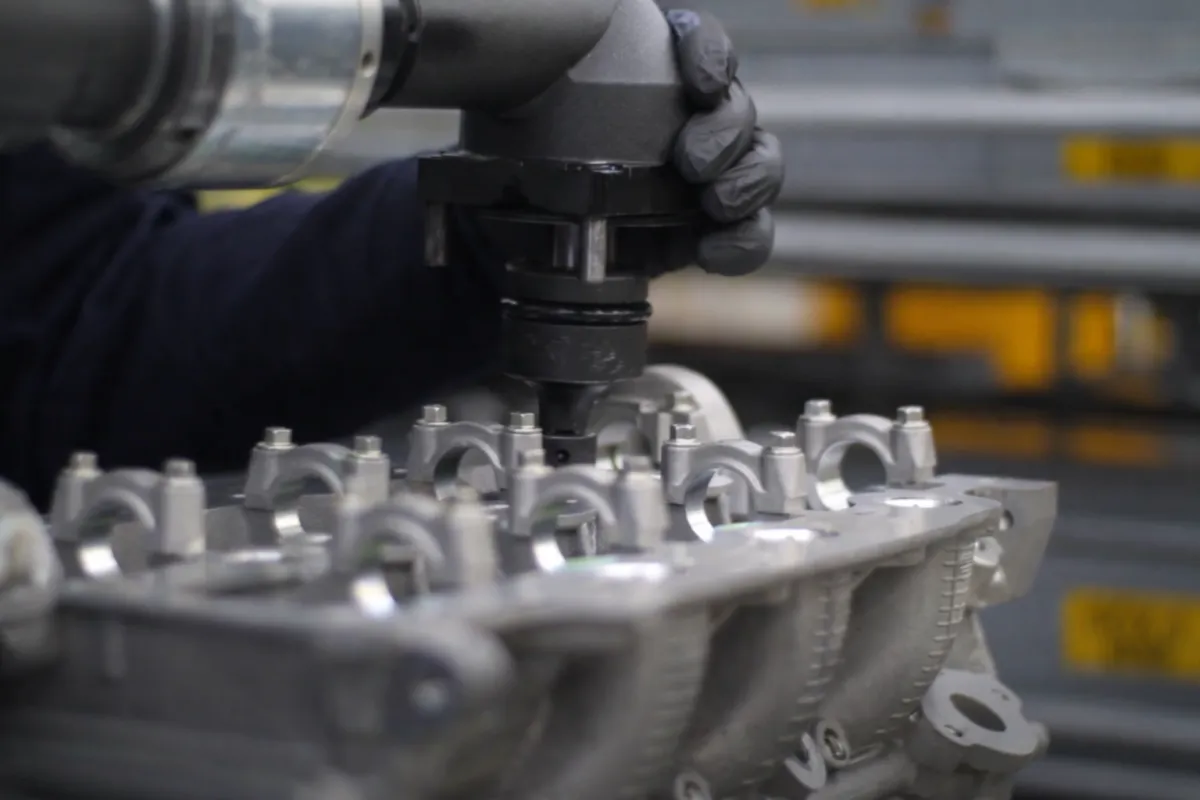
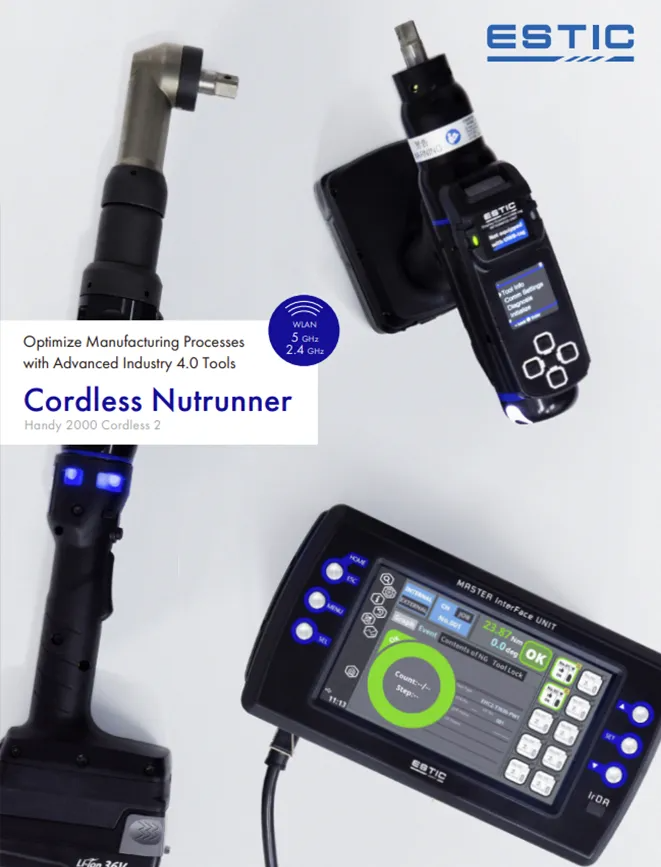
ESTIC offers both corded and cordless pulse tools, allowing the fastening concept to be matched to the workstation. The corded EH2 Series is designed for fixed production environments and covers applications up to 180 Nm, while the cordless EHC2 Series provides greater operator mobility with a range up to 100 Nm. Both use ESTIC's pulse fastening technology to minimize reaction force while supporting torque and angle monitoring, multiple fastening presets and integration with production systems. ESTIC's cordless technology is specifically designed to provide controlled fastening while eliminating cables in difficult-to-access or mobile assembly applications.
| Specification | Corded Pulse Tools | Cordless Pulse Tools |
| Model | EH2 Series | EHC2 Series |
| Covering range | 1–180 Nm | 1–100 Nm |
| Versions | Pistol, Angle | Pistol, Angle |
| Number of presets | 99 | 99 |
| Drive | Transducerized Pulsing | Transducerized Pulsing |
| Reaction device needed? | No* | No* |
| Monitoring | Torque & Angle data | Torque & Angle data |
| Communication | Open Protocol, Fieldbus, Toolsnet | Open Protocol, Fieldbus, Toolsnet |
| Controller | HT45/50 Series | EHC2-MIF Series |
| Controller capacity | 1 tool/controller | Up to 10 wireless tools/controller |
The main choice is therefore fixed-station performance versus freedom of movement. For a dedicated workstation, the corded EH2 Series provides the broader torque range. Where operators need to move around large assemblies or reach difficult fastening positions, the EHC2 Series removes the cable while retaining controlled, traceable fastening. ESTIC specifically highlights cordless applications around vehicle wheels and interior components, where unrestricted tool movement can simplify the assembly process.