Manufacturers are under constant pressure to improve productivity, reduce defects, and maintain consistent quality across increasingly complex production environments. One technology that plays a central role in this effort is the Manufacturing Execution System (MES).
If you're wondering what is MES in manufacturing, an MES is a software system that manages, monitors, and tracks production activities in real time. It acts as the bridge between enterprise planning systems and the shop floor, providing visibility into production performance, traceability, scheduling, and reporting.
For a more detailed explanation of MES and its role in manufacturing operations, read our article: What is MES (Manufacturing Execution System)?
While MES platforms are incredibly valuable, many manufacturers discover that implementing an MES alone does not automatically eliminate quality problems. The reason is simple: most quality issues originate where the work is actually performed, on the shop floor.
A modern MES in manufacturing provides production visibility, data collection, and traceability. However, it often stops short of guiding operators through the exact actions required to perform work correctly.
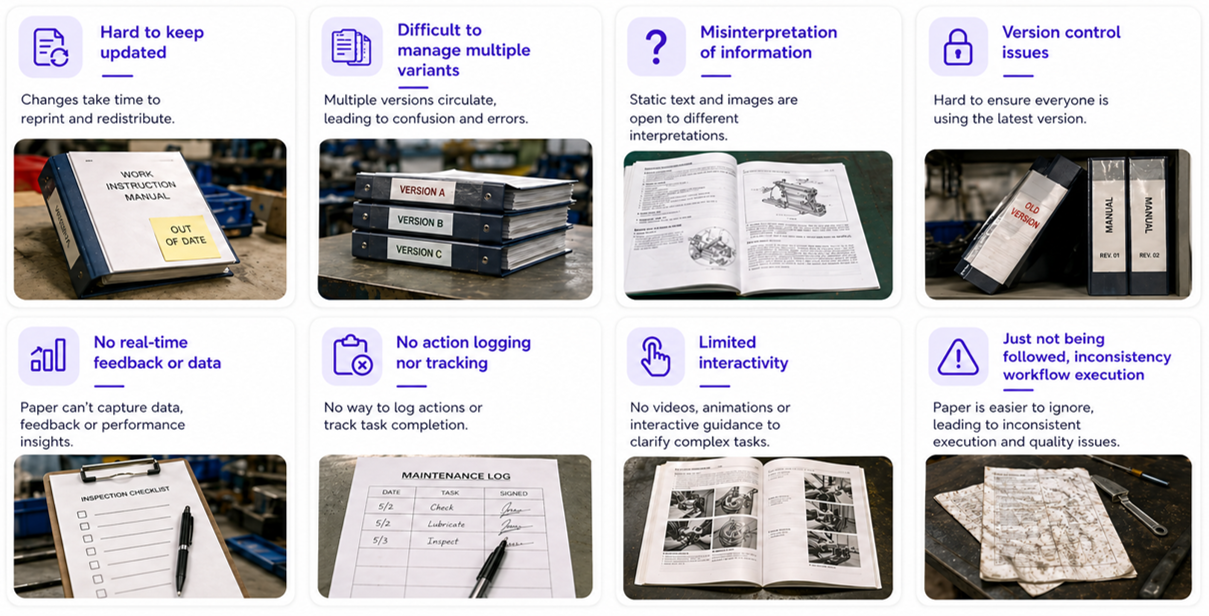
Many MES vendors offer a work instruction module, but in practice these modules are frequently limited to static PDF documents that operators can consult when needed. This creates several challenges:
As a result, the MES records what happened, but it does not necessarily prevent mistakes from happening in the first place.
The greatest risk of human error exists during the actual execution of work. Operators make decisions, perform assembly tasks, interact with machines, use tools, and complete quality checks in real time.
This is where manufacturers need a more granular layer of process control.
Traditional MES solutions excel at managing production processes at a high level, but they often lack:
To truly improve quality, manufacturers need visibility into both the process and the execution of the process.
This is where the concept of Poka Yoke manufacturing becomes important.
So, what is Poka Yoke in manufacturing?
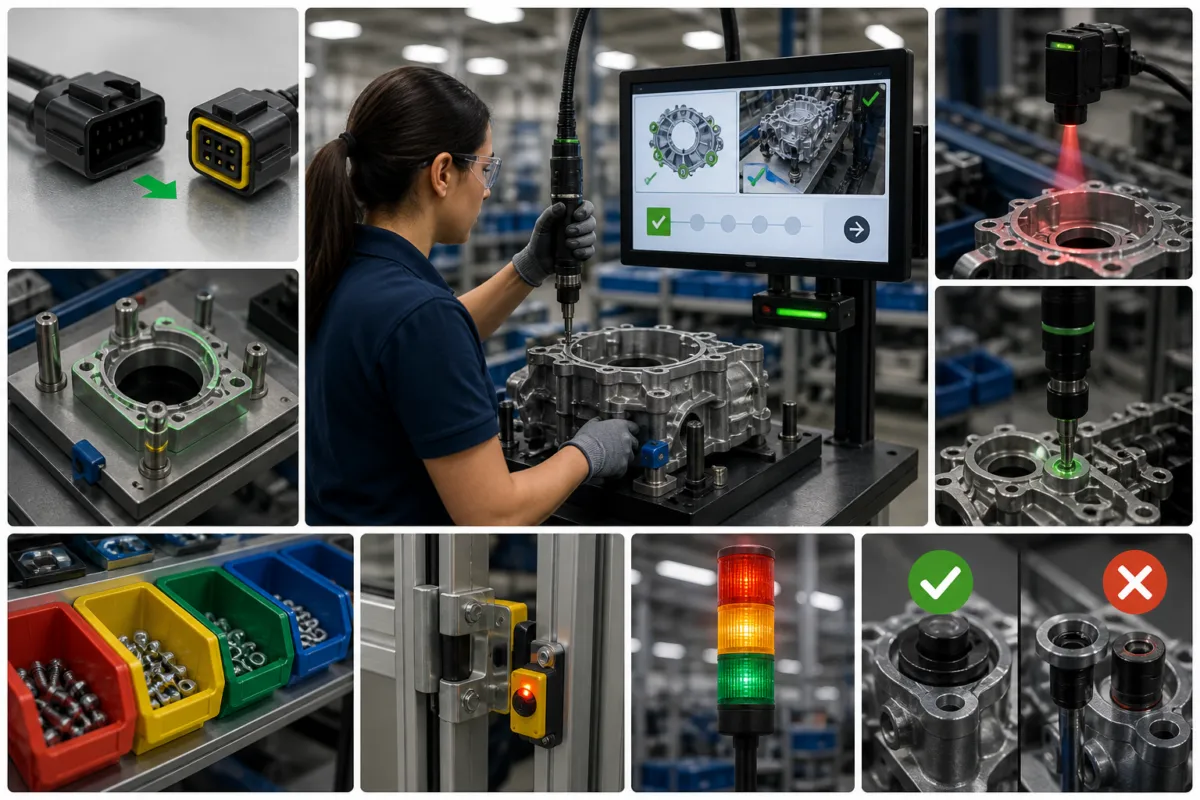
Poka Yoke refers to mistake-proofing techniques that prevent defects before they occur. Originally developed as part of the Toyota Production System, Poka Yoke in lean manufacturing focuses on designing processes that make it difficult—or impossible—for operators to make errors.
Examples include:
While MES systems provide oversight, Poka Yoke mechanisms actively prevent errors during execution.
The challenge is that effective Poka Yoke requires a system capable of interacting directly with operators, tools, machines, and quality controls in real time.
This is where digital work instructions and advanced operator guidance platforms add value.
Unlike static PDF documents, digital work instructions provide contextual, interactive guidance tailored to:
With a modern operator guidance platform, instructions become dynamic workflows rather than passive documents.
Operators receive exactly the information they need, at the moment they need it.
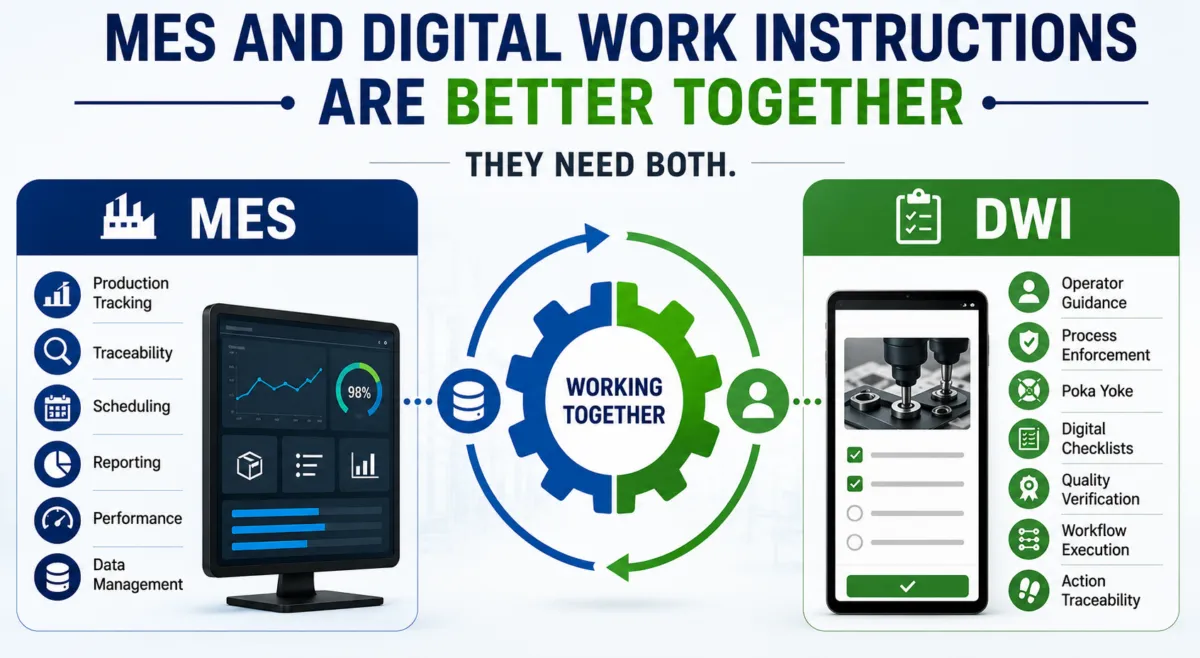
The reality is that manufacturers do not need to choose between MES and Digital Work Instructions (DWI).
They need both.
Each system serves a different purpose:
MES Strengths
DWI Strengths
Together they create a complete digital manufacturing ecosystem.
A Digital Work Instruction platform can integrate seamlessly with an MES through automated data exchange.
A common workflow looks like this:
The MES remains the operational backbone, while the DWI platform acts as the execution layer that ensures work is performed correctly.
Many manufacturers invest heavily in machine automation while overlooking the human component of production.
However, people remain central to most manufacturing processes.
Modern process control software should therefore focus not only on machines and production data but also on operator performance and process execution.
A human-centric process control approach enables manufacturers to:
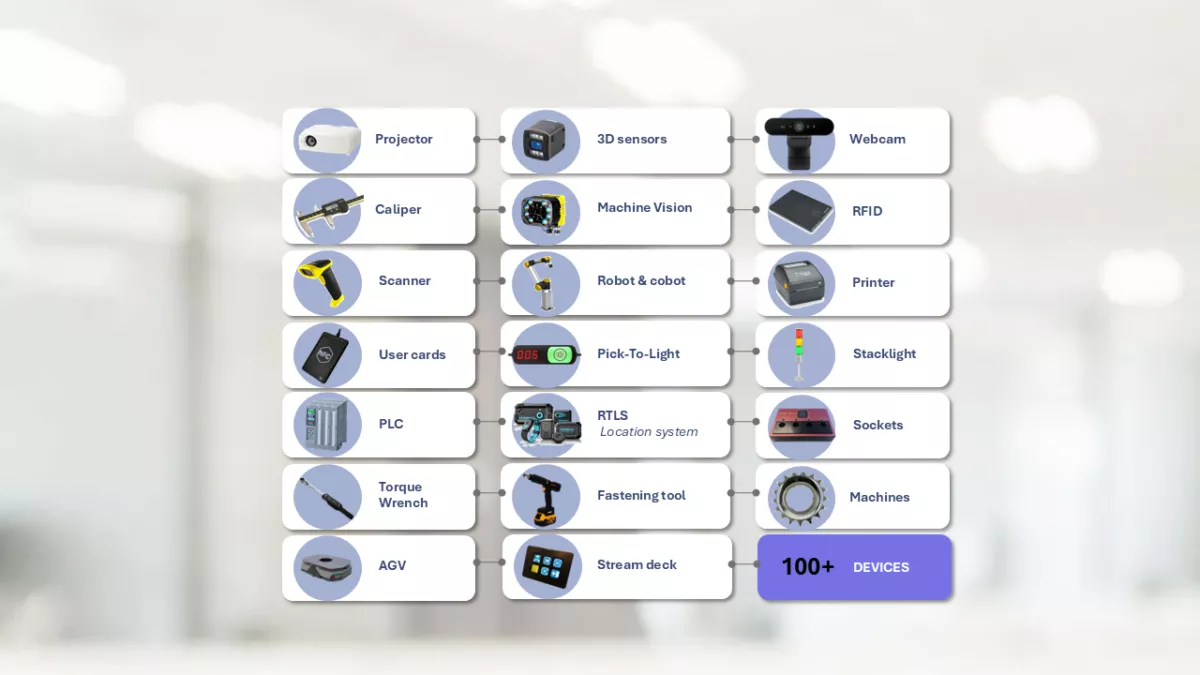
An advanced DWI platform also provides a flexible framework for managing the systems that directly influence quality.
Examples include:
Machine Vision Systems
By bringing these quality-critical elements together, manufacturers gain greater control over the factors that actually determine product quality.
MES platforms are essential for modern manufacturing operations, but they are not designed to solve every quality challenge on their own.
Most quality issues occur at the point where work is executed. That is where operators make decisions, use tools, interact with machines, and perform quality checks.
To reduce defects and implement effective Poka Yoke manufacturing strategies, manufacturers need a more detailed execution layer built around operator guidance, process control, and real-time quality enforcement.
The combination of MES in manufacturing and modern digital work instructions provides the best of both worlds: production visibility from the MES and mistake-proof execution from the shop floor.
When these systems work together, manufacturers can achieve higher quality, greater consistency, and stronger operational performance.
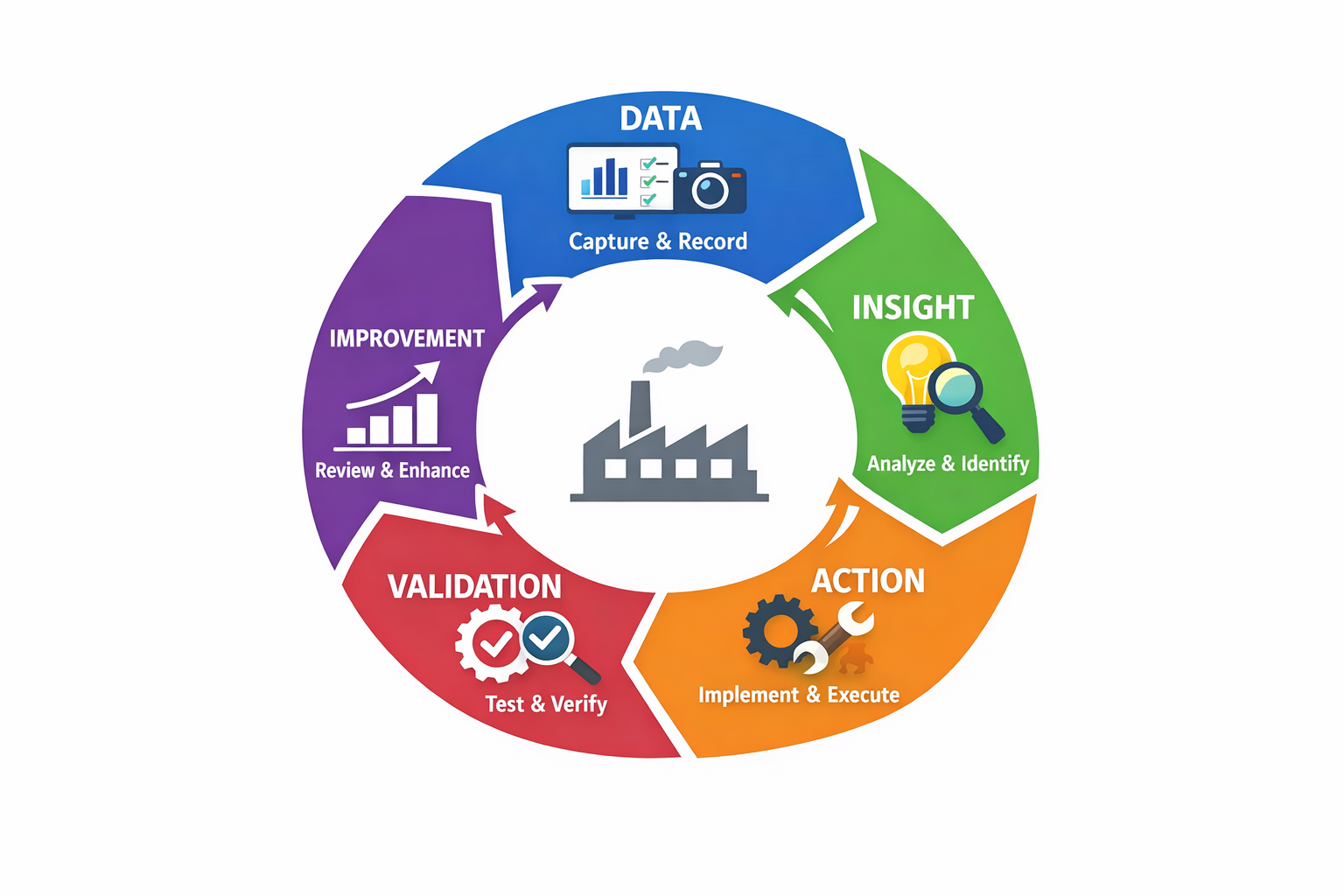
The most effective manufacturing environments combine MES and digital work instructions. MES provides visibility, traceability, and production control, while digital work instructions ensure operators perform every step correctly the first time. Together, they create a foundation for both operational excellence and continuous quality improvement.
| Capability | MES (Manufacturing Execution System) | Digital Work Instructions & Error Proofing |
|---|---|---|
| Primary purpose | Track and manage production execution | Guide operators and prevent mistakes during execution |
| Focus | Monitoring and recording processes | Ensuring processes are performed correctly |
| Production visibility | ✓ Real-time production status | Limited |
| Traceability | ✓ Records who did what and when | ✓ Records actions and process compliance |
| Work instructions | Basic document display | ✓ Interactive step-by-step guidance |
| Operator support | Limited | ✓ Visual instructions, images, videos, and prompts |
| Error prevention | Limited | ✓ Built-in validation and mistake-proofing (Poka Yoke) |
| Quality control | Detects quality issues after they occur | Prevents quality issues before they occur |
| Process enforcement | Limited | ✓ Ensures operators follow the correct sequence |
| Training new operators | Relies on external documentation | ✓ Embedded guidance reduces training time |
| Data collection | ✓ Extensive production and process data | ✓ Process and quality execution data |
| Root cause analysis | ✓ Helps analyze historical issues | ✓ Captures process deviations at the source |
| Impact on defects | Indirect | Direct reduction of operator-related defects |
| Best use case | Production management and traceability | Quality assurance and operator guidance |
| Greatest strength | Visibility into manufacturing operations | Consistent execution and error prevention |
| Greatest limitation | Doesn't prevent human errors on its own | Doesn't replace production planning or tracking |
MES platforms are essential for modern manufacturing operations, but they are not designed to solve every quality challenge on their own.
Most quality issues occur at the point where work is executed. That is where operators make decisions, use tools, interact with machines, and perform quality checks.
To reduce defects and implement effective Poka Yoke manufacturing strategies, manufacturers need a more detailed execution layer built around operator guidance, process control, and real-time quality enforcement.
The combination of MES in manufacturing and modern digital work instructions provides the best of both worlds: production visibility from the MES and mistake-proof execution from the shop floor.
When these systems work together, manufacturers can achieve higher quality, greater consistency, and stronger operational performance.