-
Operator Guidance

Ansomat Management System
- Schroefsystemen
- Oplossingen
- Industrie
- Referenties
- Boek een demo
- Free trial

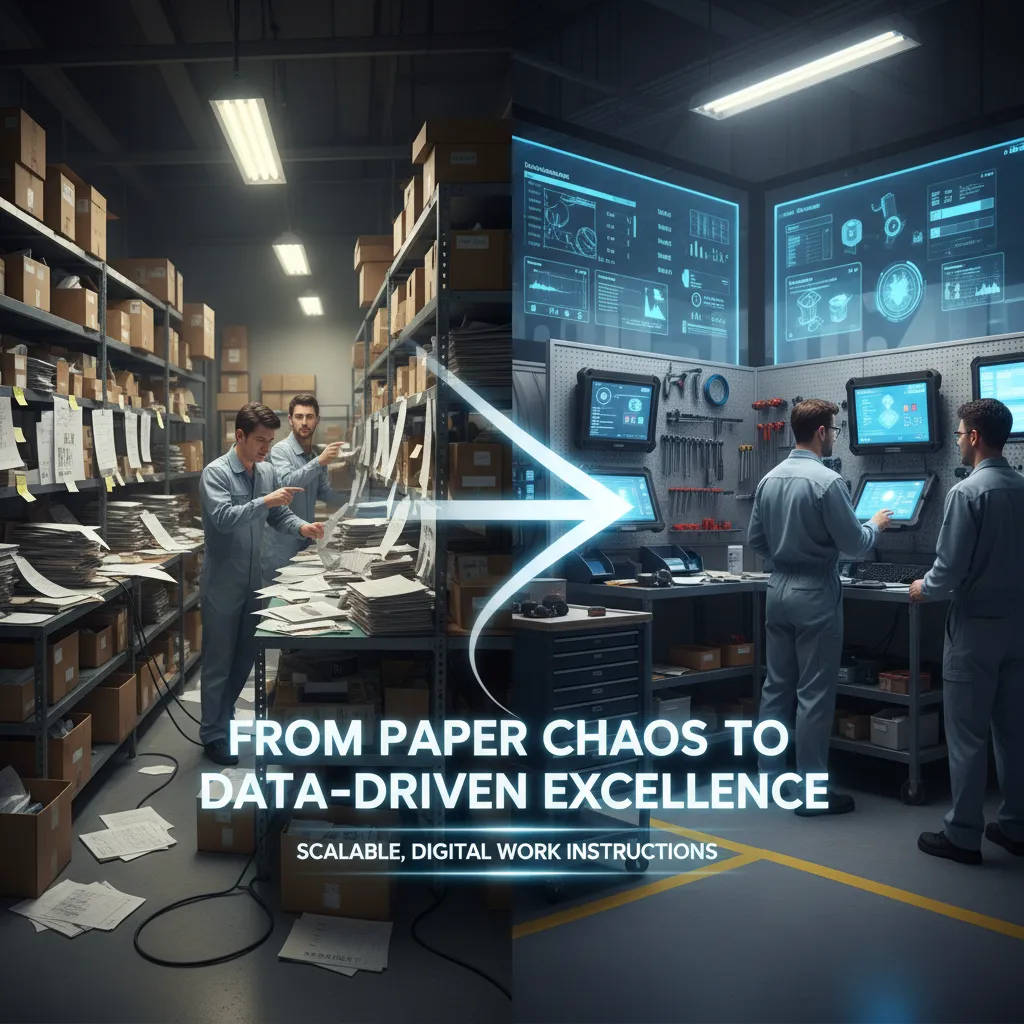
As manufacturing processes grow more advanced and interconnected, the need for precise, easy-to-follow work instructions continues to increase. They serve as the foundation for standardizing tasks, ensuring consistency, and maintaining high levels of quality across operations. Clear and accessible work instructions guide operators through each step of a process, reducing variability, minimizing the risk of human error, and helping teams meet production targets efficiently.
This is especially critical in industries such as automotive, aerospace, electronics, and industrial equipment, where a single mistake can result in costly rework, safety issues, or compromised product quality. Digital work instructions not only improve performance but also support regulatory compliance and traceability, making them a vital part of any quality-driven production environment.
As manufacturing evolves toward the principles of Industry 5.0, the focus is shifting toward software for work instructions that support collaboration between human workers and machines. Work instruction software play a central role in this transformation. They provide the flexibility and connectivity required to meet the needs of a more dynamic, human-centered production environment.
New technologies such as artificial intelligence, machine vision, and advanced robotics are increasingly integrated into production systems. To match this level of sophistication, instructions must be adaptable, always up to date, and capable of delivering information in an intuitive and actionable format. Digital platforms ensure that workers have access to the latest procedures in real time, eliminating confusion caused by outdated documents or printed manuals.
Moreover, digital work instructions can be enriched with multimedia elements like videos, animations, or augmented reality overlays. These features make it easier for operators to understand complex steps and complete their tasks with greater accuracy. The ability to personalize instructions based on skill level, job role, or language also contributes to a more inclusive and effective working environment.

When selecting a work instruction platform for your factory or production line, several key criteria should be taken into account. This to ensure the software aligns with your operational goals and technological infrastructure.
The first and perhaps most important factor is ease of use. A system that is too complex to maintain or too difficult for users to navigate will not be adopted effectively. Many manufacturers face challenges when key users leave and the remaining staff struggle to update or adapt the system. Selecting a platform that is intuitive and simple to manage ensures long-term usability and scalability.
Device flexibility is another practical aspect to evaluate. Depending on your workspace, you may prefer tablets or smartphones for mobility, especially in large or hard-to-reach areas. On the other hand, fixed screens such as desktop computers offer more stability and allow for the integration of peripheral devices and sensors.
Wearables and AR glasses provide a hands-free option that is particularly useful in high-complexity or safety-sensitive environments, where the operator must remain focused and mobile at the same time.
The next consideration is the level of quality control required in your process. If your production involves high-cost or high-risk components, you may want to explore options that offer integrated errorproofing mechanisms. This could include the use of smart fastening tools that verify torque and angle in real time, vision systems that validate correct execution of steps, or real-time location tracking that ensures tools and parts are used in the correct sequence and location.
Some manufacturers aim for what is referred to as a no fault forward environment. This concept refers to a production setup where mistakes are prevented by design, using intelligent systems that guide and verify each action performed by the operator. When combined with a well-structured digital instruction system, such an approach greatly reduces variability and ensures a high level of quality without compromising the role of the human operator.
System integration capabilities are also crucial. A modern work instruction platform should be able to connect with your existing manufacturing systems such as MES, ERP, or PLCs. Support for communication protocols like OPC UA, MQTT, or Siemens S7 allows for smooth data exchange and enables automated feedback loops between machines and instructions. The result is a more connected and responsive production environment.
Another powerful feature to consider is augmented reality support. AR technology can overlay digital guidance directly onto the physical workspace, providing real-time visual cues and helping operators follow complex steps without needing to shift focus.
This not only improves training and reduces onboarding time for new employees but also enhances performance in scenarios where precision is critical.
Investing in digital work instruction solutions is not just about replacing paper documents with electronic versions. It is about creating a smarter, safer, and more efficient workplace that empowers operators and supports continuous improvement. By choosing a solution that meets your technical requirements, integrates seamlessly into your ecosystem, and enhances the operator experience, you are preparing your organization for the demands of modern manufacturing and beyond.
Now is the time to rethink how knowledge is delivered on the factory floor. With the right tools in place, you can bridge the gap between human skill and digital innovation, driving both performance and satisfaction across your production teams.

Begin met een use case waarbij de voordelen snel zichtbaar worden. De ideale eerste pilot is niet je meest geavanceerde proces, maar ook niet het eenvoudigste, waar de impact misschien te beperkt is om op te merken.
Bij Ansomat kan je een gratis proef aanvragen om het volledige potentieel van digitale werkinstructies te verkennen met een minimaal risico. Het organiseren van een demodag via ons of een van onze partners is ook een goede manier om van start te gaan: nodig belanghebbenden uit van procestechniek, SOP-teams, teamleiders op de werkvloer, productie en kwaliteit. Door hen de oplossing uit eerste hand te laten ervaren, bouwt u al in een vroeg stadium aan afstemming, buy-in en momentum.
Begin klein en gecontroleerd. Test je instructies met een "proefkonijn" in een veilige omgeving voordat je ze breed uitrolt. Het belangrijkste is om te observeren of de instructies zinvol zijn zonder extra uitleg, eventuele fouten of vragen zullen snel gaten of onduidelijke stappen aan het licht brengen.
Test met operatoren van verschillende vaardigheidsniveaus, zowel ervaren als onervaren, om de verschillende behoeften te begrijpen. Sommige van onze klanten met meer dan 50 stations gebruiken zelfs een speciaal "teststation" waar nieuwe technologische integraties en mogelijkheden worden getest.
Het opstarten gaat snel en is afhankelijk van de complexiteit van je installatie en de betrokken apparaten.
Voor grotere implementaties hangen tijdlijnen voornamelijk af van:
Als de basis er eenmaal is, gaat het schalen in de fabriek aanzienlijk sneller.
Als je meerdere productvarianten beheert, hoef je werkinstructies niet helemaal opnieuw op te bouwen. Gemeenschappelijke stappen kunnen worden hergebruikt voor meerdere varianten, vergelijkbaar met het gebruik van dezelfde stap "kerstomaten" in meerdere recepten. Alleen de stappen die verschillen worden één keer gemaakt en het systeem stelt automatisch de juiste instructiestroom samen voor elke variant.
Met digitale werkinstructieplatforms kunnen instructies centraal worden aangemaakt, gedistribueerd en onderhouden. Dit maakt het eenvoudig om instructiesets te schalen, te dupliceren en aan te passen tussen stations met gelijkaardige operaties, zonder opnieuw te moeten beginnen.
Met het Ansomat Management System zijn instructies centraal toegankelijk en kunnen ze worden bijgewerkt, wijzigingen kunnen in realtime worden gecontroleerd en zowel instructeurs als operatoren op de werkvloer werken altijd met de meest recente versie.
Operatoren kunnen directe feedback geven over elke afzonderlijke instructiestap. Ze kunnen stappen beoordelen en commentaar geven zoals "verkeerde volgorde", "niet duidelijk" of "visueel moet verbeterd worden".
Alle feedback wordt automatisch vastgelegd en opgeslagen in een centrale database. Continu verbeterteams kunnen deze input rechtstreeks van hun bureau bekijken met het Ansomat Management System, de verzoeken evalueren, de werkinstructies bijwerken en de goedgekeurde wijzigingen onmiddellijk terugsturen naar de werkvloerstations. Zo ontstaat een snel verbeteringsproces tussen operatoren en engineeringteams.
Digitale werkinstructies moeten worden bevestigd om naar de volgende stap te gaan. Dit kan handmatig of volledig automatisch gebeuren, afhankelijk van uw instelling.
Handmatige bevestigingsopties zijn onder andere
Om het proces verder te automatiseren, kunnen slimme apparaten worden geconnecteerd zodat stappen automatisch worden gevalideerd: