-
Guidage des opérateurs

Ansomat Management System
- Outils de serrage
- Nos solutions
- Industries
- Références
- Réserver une démo
- Free trial

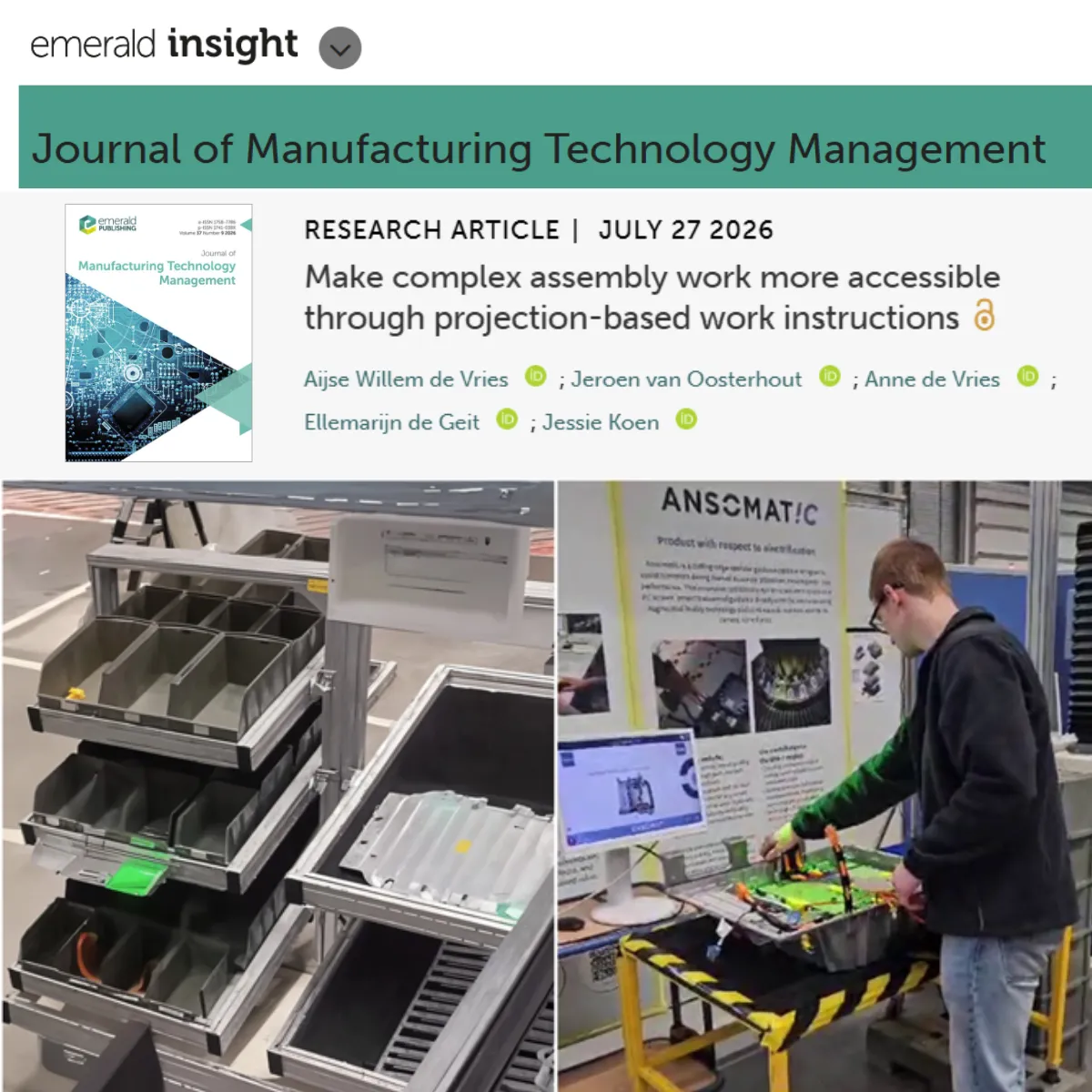
What is the real impact of digital work instructions on the manufacturing floor? Newly published scientific research by Emerald provides compelling evidence: projection-based digital work instructions resulted in 16–20% faster task completion, 46–60% fewer errors and 69–83% fewer requests for help.
And the impact goes beyond productivity and quality.
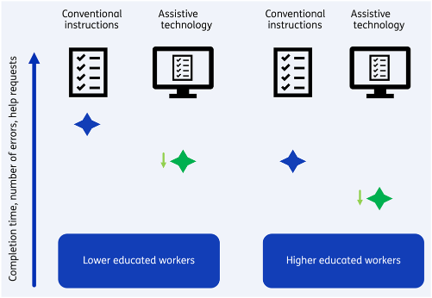
The research also found that participants with a lower educational background using digital work instructions performed at a comparable level to higher-educated participants working with traditional paper instructions.
For manufacturers facing increasing product complexity, knowledge loss and a structural shortage of skilled workers, the findings make a strong case for digital operator guidance: technology can make complex assembly faster and more reliable, while simultaneously making it accessible to a broader workforce.
During the study, participants were tasked with assembling an automotive battery. Their performance with projection-based digital work instructions was compared to traditional ways of providing assembly instructions.
The results show significant improvements across three critical manufacturing KPIs:
📈 16–20% faster task completion
🎯 46–60% fewer errors
🙋 69–83% fewer requests for help
These aren't just improvements in how operators experience their work. They represent outcomes that can directly affect manufacturing performance.
Faster assembly means increased productivity and potential throughput. Fewer errors can mean less rework, scrap and quality-related costs. Fewer requests for assistance can reduce the amount of time supervisors and experienced colleagues need to spend supporting other operators.
Together, these findings provide strong quantitative evidence for the business case behind digital operator guidance.
For manufacturers evaluating digital work instructions, the key question is ultimately not whether the technology looks impressive. The question is: what does it deliver on the shop floor?
The study provides measurable inputs to that business case.
Imagine the potential cumulative effect of reducing assembly time by up to 20% across hundreds or thousands of production cycles. Or the cost impact of reducing assembly errors by up to 60%. Or freeing experienced employees from a significant share of the questions and interventions currently required to keep production running.
The exact financial ROI will naturally differ between factories, processes and products. Labor costs, production volumes, error costs, training requirements and process complexity all play a role.
But the operational drivers behind that ROI are clear: higher productivity, better quality and greater operator independence.
And there is another benefit that may prove even more valuable in today's labor market.
The research suggests that it can.
One of the study's most important findings was the effect digital work instructions had on the performance gap between participants with different educational backgrounds.
Lower-educated participants supported by digital work instructions performed at a comparable level to higher-educated participants using traditional paper instructions.
That finding changes the conversation around digital work instructions.
They aren't simply a more modern replacement for paper manuals. Used effectively, they can help transfer expertise from the individual operator into the production process itself.
Instead of expecting every new operator to first acquire extensive product and process knowledge, digital guidance can provide that knowledge exactly when and where it is needed.
This matters because manufacturing companies are dealing with two challenges at the same time.
On the one hand, products and assembly processes are becoming increasingly complex. High-mix, low-volume production, increasing customization and shorter product lifecycles require operators to deal with more variants, more instructions and more frequent changes.
On the other hand, experienced technical workers are increasingly difficult to find.
Much of the knowledge needed to perform complex assembly is traditionally built up through experience. When experienced employees retire or leave, part of that knowledge risks disappearing with them. New employees require training and supervision before they can work independently.
Digital operator guidance offers another approach.
By capturing manufacturing knowledge digitally and presenting the right information to the operator at the right moment, companies can make expertise available directly at the workstation.
Projection-based guidance takes this one step further by bringing instructions into the operator's physical working environment.
The result can be a shorter path from “new operator” to “productive operator.”
The 69–83% reduction in requests for help is particularly interesting in this context.
A request for help doesn't only interrupt the operator performing the task. It also requires the attention of someone else — often a supervisor, team leader or experienced colleague whose knowledge is already a scarce resource.
Reducing that dependency can therefore have an effect beyond the individual workstation.
Experienced employees can spend more of their time on activities where their expertise creates the greatest value, while less experienced operators can work with greater independence and confidence.
For organizations dealing with labor shortages, this creates a potentially powerful multiplier effect.
The implications also extend into recruitment and onboarding.
If technology reduces the amount of prior knowledge required to successfully perform complex assembly, manufacturers may no longer need to recruit exclusively from a limited pool of highly experienced workers.
Instead, they can potentially recruit from a broader group of candidates and use technology to support them in developing competence on the job.
This can help manufacturers:
In a tight labor market, that last point is becoming increasingly important.
At Ansomat, this is central to how we think about the future of manufacturing.
Automation is not always about removing the human operator from production.
In complex, variable and high-value assembly processes, people continue to bring flexibility, judgement and problem-solving capabilities that are extremely valuable.
Technology can amplify those capabilities.
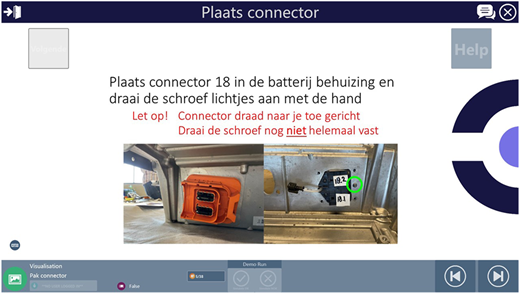
Digital operator guidance can take complexity away from the operator by making the next action clear, providing information at the point of use and supporting correct execution throughout the process.
The objective is therefore not simply a more digital factory.
It is a factory where people can perform complex work faster, more accurately and with less dependency on prior experience.
Perhaps that is the most significant conclusion of the research.
Investments in manufacturing technology are traditionally justified by productivity, quality or cost reduction. Inclusive technology adds another dimension: the same investment can potentially make work accessible to people who might otherwise struggle to perform it successfully.
The research demonstrates that these objectives don't necessarily compete with each other.
They can reinforce each other.
And lower-educated participants using digital instructions performing comparably to higher-educated participants using traditional paper instructions.
For manufacturers, that combination is particularly powerful.
It means the business case for digital operator guidance isn't only about doing the same work faster.
It's about creating a production environment in which more people can do complex work successfully — with higher productivity, better quality and greater independence.
That is what human-centered manufacturing should deliver.
The research is closely connected to a real manufacturing challenge at VDL Nedcar, where Ansomat Operator Guidance was implemented to support complex manual EV battery assembly. VDL moved from a largely paper-based, operator-dependent process to an integrated digital workflow combining projection-based work instructions, guided picking, machine vision, smart fastening tools and real-time process validation. Operators are visually guided through picking and assembly, while critical actions are verified before production can continue. The result is a standardized, no-fault-forward process that reduces dependency on individual operator experience, supports multiple battery variants, improves traceability and enables faster onboarding. In collaboration with TNO, VDL also tested the approach with groups of different experience levels, including participants with little or no manufacturing experience — providing the real-world setting behind the broader question of whether digital guidance can make complex assembly accessible to more people. Discover the full VDL EV Battery Assembly case →
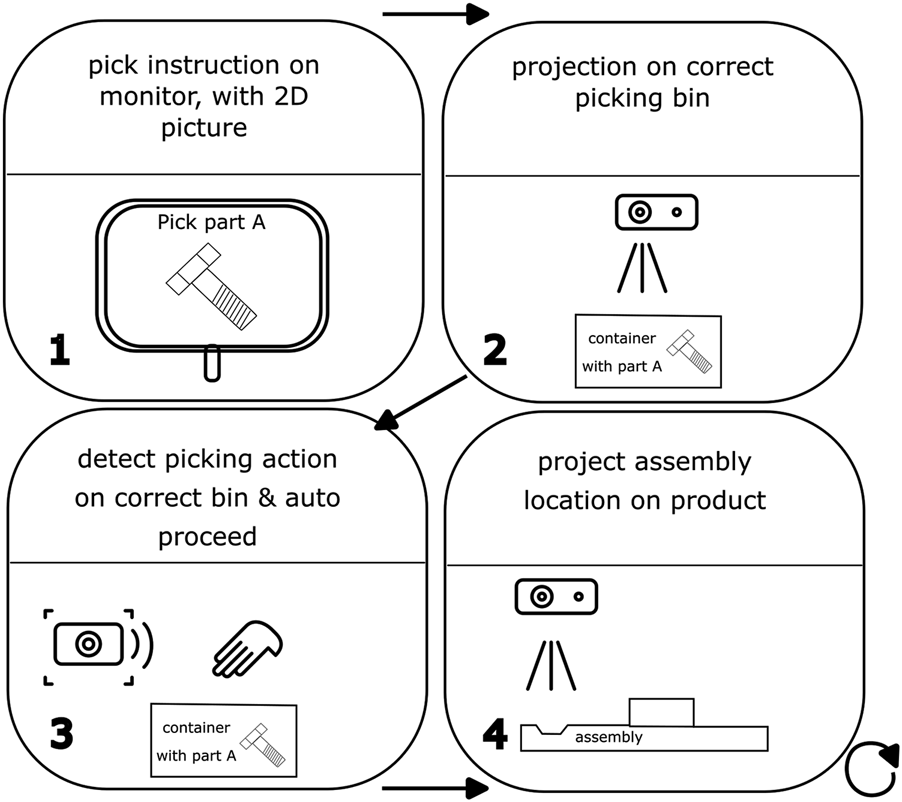
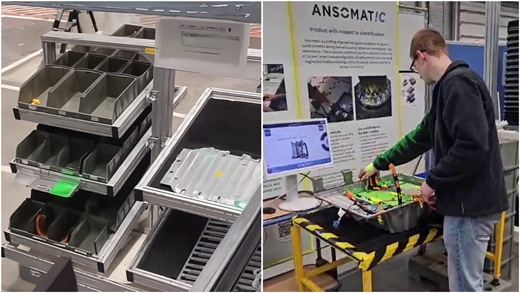
The study “Make complex assembly work more accessible through digital work instructions” investigates how projection-based digital work instructions affect the execution of complex assembly work and whether this technology can help reduce performance differences between workers with different educational backgrounds.
The research involved an automotive battery assembly task and examined performance across measures including task completion time, errors and requests for assistance.
The work is connected to research involving TNO Healthy Living and Human Resource Studies at Tilburg University, with contributions and support from Instituut Gak, VDL Nedcar and VISTA College.
The findings add scientific evidence to an increasingly important question for manufacturing companies:
How can we use technology not only to make manufacturing more productive, but also to make complex work accessible to more people?
The full study, “Make complex assembly work more accessible through digital work instructions,” is published in the Journal of Manufacturing Technology Management by Emerald Publishing.
Read the full scientific publication:
https://www.emerald.com/jmtm/article/37/9/125/1388917/Make-complex-assembly-work-more-accessible-through